
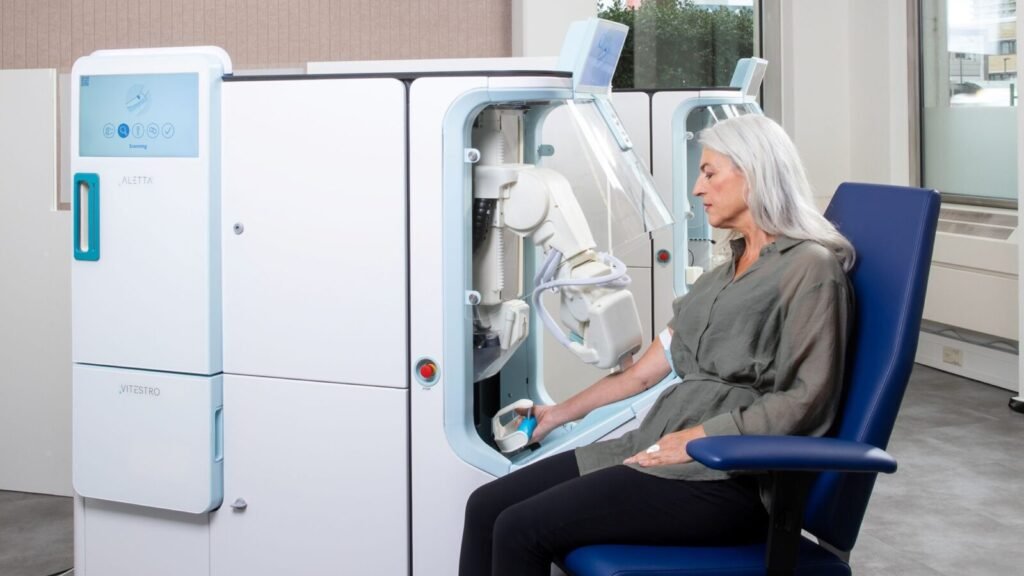
Blood draws are among the most common medical procedures in the United States, yet many patients experience delays because of a nationwide shortage of trained phlebotomists. The U.S. Food and Drug Administration has authorized a fully autonomous robotic blood‑draw device called “Aletta”, developed by Vitestro in the Netherlands, to help address this gap. The authorization allows the system to be used in adult outpatient settings under the oversight of a supervisor trained in phlebotomy.
Aletta autonomously performs every step of a venipuncture procedure once a patient or supervisor presses a button to begin. The device first guides the patient to position their arm correctly. It then uses multimodal imaging, combining near‑infrared light with Doppler ultrasound, to locate a suitable vein and confirm that it is not an artery. If no appropriate vein is found, the system will not attempt a blood draw. After identifying a vein, Aletta applies a tourniquet, prepares the skin, inserts and later disposes of the needle, changes collection tubes, and applies a bandage. A supervising phlebotomist remains nearby to respond to issues and verify that tubes are filled in the correct order and to adequate volume.
The FDA based its authorization on clinical data showing that Aletta’s successful blood‑draw rates were comparable to or better than those achieved by trained human phlebotomists. Trials included patients with a wide range of health statuses, including individuals who reported difficult vein access and those with varying skin tones. Device‑related adverse events were uncommon and mild. The agency emphasized that this authorization supports its commitment to advancing innovative medical devices that meet critical public health needs while maintaining safety and effectiveness.
Aletta incorporates multiple safety features. During ultrasound scanning, the device continuously applies disinfectant to the skin. It is cleaned between patients by trained personnel. If a patient moves excessively during the procedure, the needle automatically detaches and the draw stops. Additional onboard sensors can pause the procedure and alert the supervisor if unsafe conditions arise. These safeguards are designed to ensure consistent performance and reduce risks associated with autonomous operation.
Here’s a video showing how Aletta works:
More info from Vitestro: Aletta
Source: FDA Press Release:
