
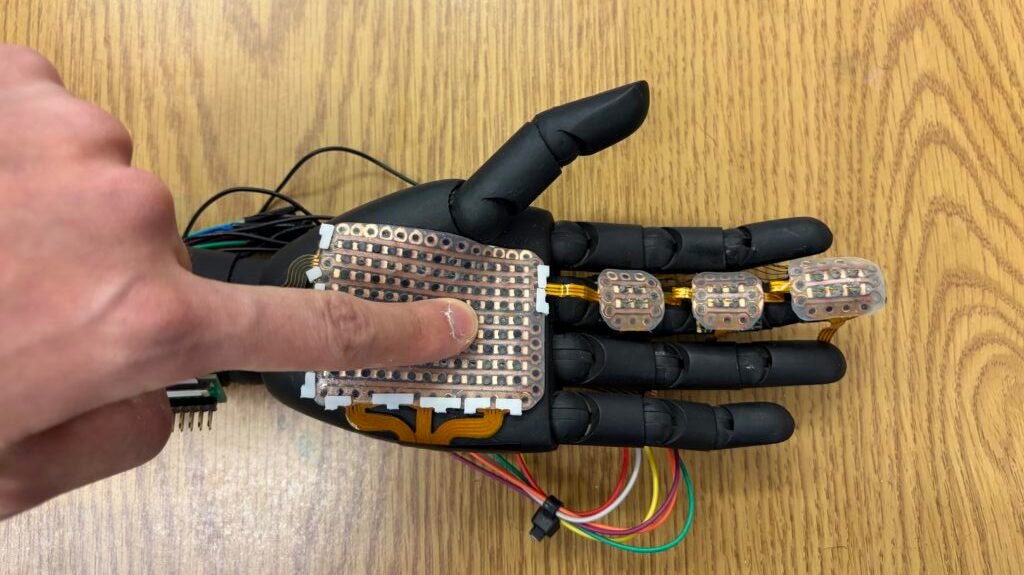
Many amputees struggle with prosthetic devices that cannot provide meaningful sensory feedback, leaving them unable to feel temperature, pressure, or texture during everyday tasks. Existing electronic skins attempt to address this gap, but they are often expensive, difficult to customize, limited in sensing resolution, and unable to conform well to curved or irregular surfaces. Researchers at Washington State University developed an electronic skin system that detects both pressure and temperature at a much finer scale than current commercial glove sensors, offering a potential path toward prosthetics that more closely mimic human tactile sensation.
The team designed a customizable sensing system built from thin, layered modules that incorporate temperature and pressure sensors. These modules act as multimodal sensing elements capable of identifying surface texture and material properties. The researchers emphasized that the system can sense at ten times a finer scale than commercial glove‑based sensors, enabling more detailed tactile recognition. The electronic skin is intended to help prosthetic devices gather rich sensory information that could eventually be transmitted to users, improving their ability to interact with objects safely and effectively.
A major challenge in electronic‑skin development is achieving high‑density sensing while maintaining comfort and mechanical reliability. Many existing systems lose performance when customized to fit individual limb shapes, and large sensing arrays often generate too much data for real‑time use. The research team addressed these issues with a “scan‑model‑print” manufacturing method. First, a scanner captures the geometry of a prosthetic limb or other freeform surface. The researchers then map sensor positions onto that geometry, ensuring seamless coverage across curved regions. Finally, the components are fabricated using 3D printing and laser cutting, allowing the electronic skin to conform naturally to the prosthetic without sacrificing sensing resolution.
The resulting system provides human‑like tactile sensing across both flat and curved surfaces. It can detect subtle variations in pressure and temperature, enabling more reliable identification of objects and environmental conditions. The researchers noted that this approach democratizes the production of medical‑grade electronic skins by making high‑resolution tactile feedback more accessible for widespread clinical use. They also highlighted that the technology lays a foundation for future bionic skin systems that may combine sensing with haptic stimulation, potentially restoring aspects of touch for amputees.
Future work will explore integrating this sensing system with prosthetic control algorithms and investigating how tactile information might be relayed to users. The team views the technology as an important step toward prosthetics that provide richer, more natural interaction with the world.
Here’s a brief video that explains more about the technology:
Article from WSU: Researchers develop electronic skin for prosthetics to sense temperature and pressure
Abstract in Cell Reports Physical Science: A geometry-aware and customizable multimodal sensing system for texture and material identification in prosthetics
