
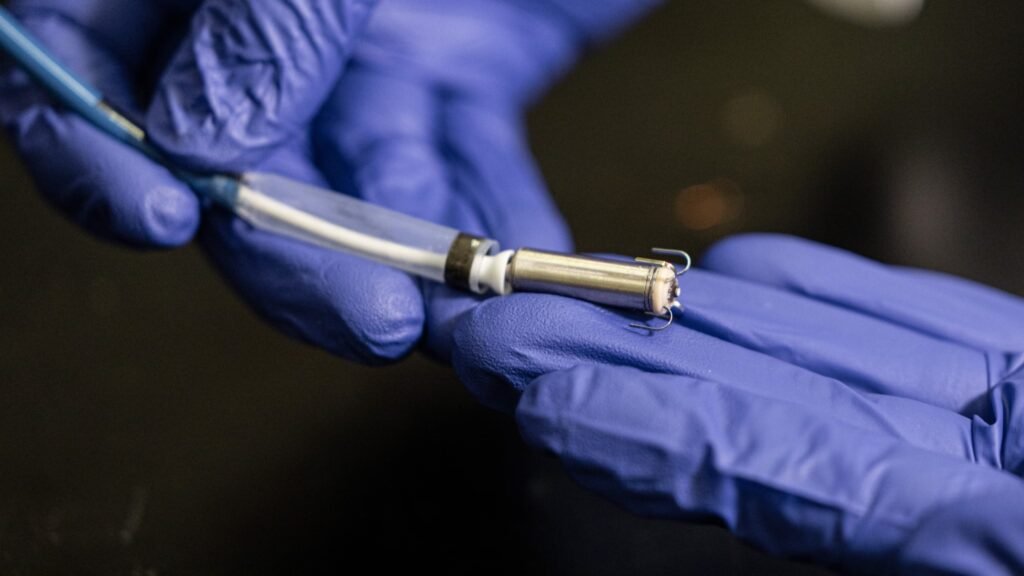
Pacemakers require periodic battery replacement, a process that can be risky, costly, and burdensome for patients who depend on long‑term cardiac rhythm management. Leadless intracardiac pacemakers reduce complications compared with traditional chest‑implanted models, but their batteries still occupy more than half the device’s size and last only seven to ten years. Removing a depleted device from inside the heart is difficult, so expired pacemakers are often left in place while new ones are implanted alongside them. Researchers at the University of Wisconsin–Madison developed a battery‑free pacemaker powered entirely by a patient’s heartbeat, offering a potential path toward implants that last a lifetime without replacement.
The team engineered a triboelectric nanogenerator small enough to fit inside the battery compartment of Medtronic‘s Micra leadless pacemaker, which is already the world’s smallest pacemaker. The device uses oscillators made of electrode plates coated with copper on one side and a fluorinated polymer film on the other. When the heart beats, its motion compresses and releases these oscillators, causing oppositely charged plates to contact and separate. This movement generates electrical energy that can either power the pacemaker directly or be stored in a small onboard capacitor. The researchers emphasized that achieving high power density in a very small volume was essential for making the system viable inside an existing intracardiac device.
Extensive testing showed that the nanogenerator produced a volumetric power density of 276.6 microwatts per cubic centimeter, an order of magnitude higher than previous designs. This output was sufficient to fully power the pacemaker. The team implanted a prototype in a pig, where it operated for a month while maintaining stable performance and biocompatibility. The researchers noted that balancing mechanical stability with flexibility required significant trial and error, including fine‑tuning the thickness of electrode plates and the placement of internal wiring to withstand millions of heartbeat‑driven compressions.
The work builds on decades of pacemaker evolution, from early bulky devices to modern leadless intracardiac systems. While these newer devices offer faster recovery and fewer complications, their battery limitations remain a major barrier to long‑term use. By replacing the battery with a heartbeat‑powered nanogenerator, the research team demonstrated a clinically compatible architecture that could eliminate generator‑replacement procedures and reduce lifetime surgical burden for patients.
Future development will focus on refining the integrated system, expanding long‑term testing, and evaluating performance across different cardiac conditions. The researchers view this technology as a step toward self‑sustaining intracardiac electronic systems that operate reliably for decades without the need for battery replacement.
Article from the University of Wisconsin: Engineers pioneer a pacemaker that can power itself
Abstract in Science Advances: Self-sustaining leadless intracardiac pacemaker powered by triboelectric nanogenerator
