
Patients in intensive care often experience rapid and dangerous changes in blood pressure, yet the standard method for continuous monitoring requires inserting a catheter directly into an artery. This approach provides accurate, beat‑by‑beat measurements but carries risks such as bleeding, clot formation, infection, and restricted mobility. Conventional arm cuffs avoid these complications but offer only intermittent readings, which can miss sudden fluctuations. Researchers at Johns Hopkins University have developed a wearable sensor system combined with artificial intelligence that generates continuous blood pressure waveforms without entering the bloodstream, offering a potential alternative to arterial lines for critical care and other settings.
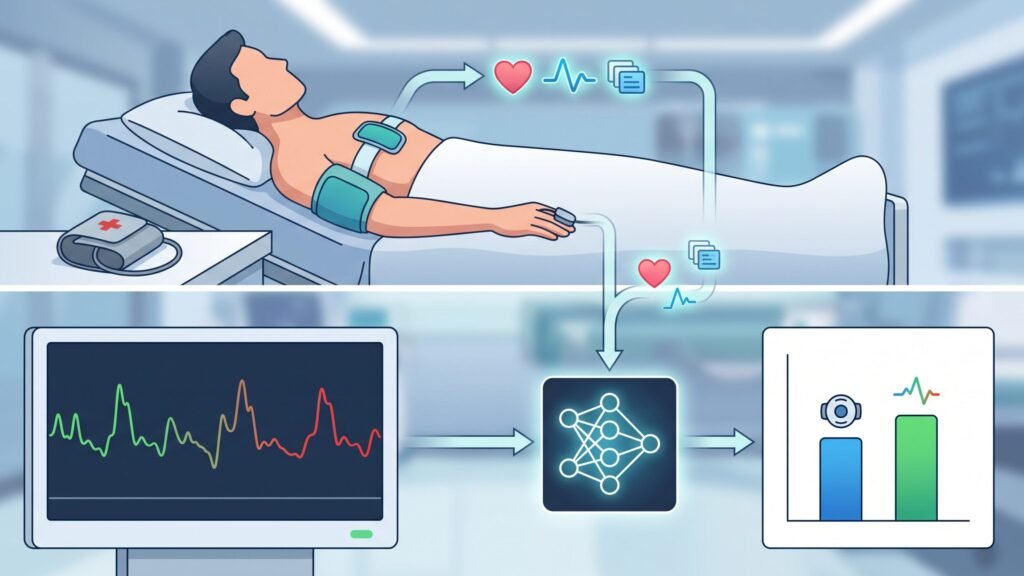
The system uses two small sensors placed on the body. One sensor sits on the chest and records electrical activity from the heart, similar to signals captured during routine cardiac monitoring. The second sensor is positioned on a finger, where it detects changes in blood volume as pulses move through the circulation. Together, these signals describe how electrical activation of the heart relates to the movement of blood through the body. The data are sent to a deep learning model that reconstructs a continuous waveform representing blood pressure over time. This waveform closely resembles the output of an arterial catheter, providing detailed information about each heartbeat.
In initial patient testing, the system produced waveforms that closely matched those recorded by traditional arterial lines. The early study included individuals in intensive care, where continuous monitoring is essential for detecting dangerous rises or falls in pressure. High blood pressure in this environment can increase the risk of stroke, heart attack, and kidney injury, while low pressure can reduce blood flow to the brain and vital organs. The wearable system aims to capture these changes without the complications associated with invasive catheters.
The researchers emphasized that the technology could eventually allow hospitals to monitor arterial blood pressure outside intensive care units. It may also support continuous monitoring for people with chronic hypertension, similar to how wearable glucose monitors assist individuals with diabetes. Because the sensors are non‑invasive and do not limit movement, they could provide a more comfortable and accessible option for long‑term tracking.
The work demonstrates that combining wearable sensors with artificial intelligence can reconstruct meaningful, accurate, and reliable blood pressure waveforms. Future development may focus on expanding testing, refining the model, and exploring how the system performs across different clinical environments. The approach offers a possible path toward safer and more flexible continuous blood pressure monitoring.
Article from Johns Hopkins: Wearable Sensors and AI Could Monitor Blood Pressure in ICU
Abstract in Computers in Biology and Medicine: Non-invasive arterial blood pressure waveform generation in critically ill patients: A sensor-based deep learning approach
