
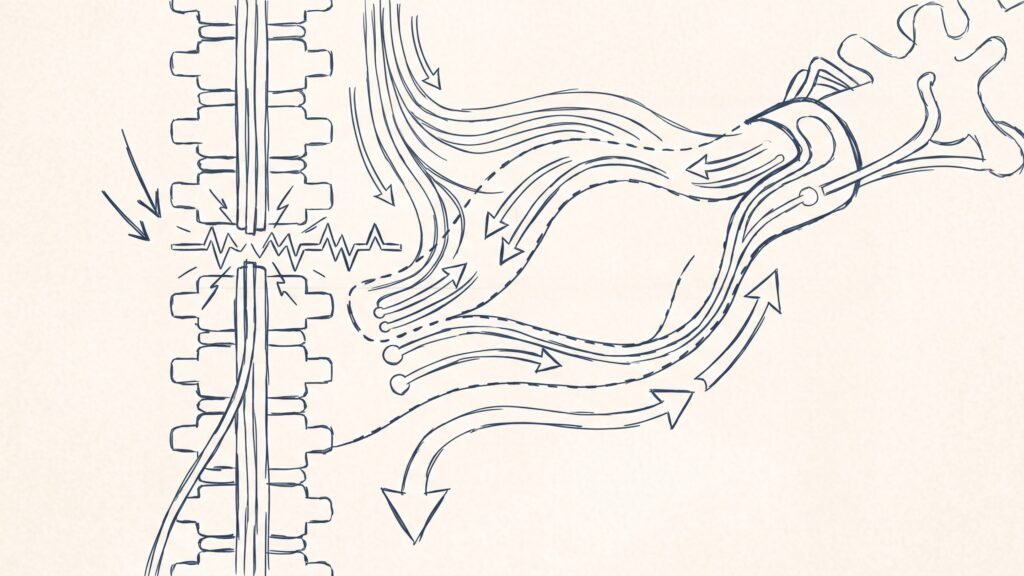
Spinal cord injuries often lead to permanent loss of movement, sensation, and autonomic control because damaged neural pathways can no longer carry signals between the brain and the body. Current technologies typically focus on restoring only one function at a time, and many approaches rely on limited remaining pathways rather than creating new routes for communication. Researchers at Houston Methodist have developed an implantable device designed to bypass the injured region of the spinal cord and restore multiple functions by rerouting neural signals around the damaged area.
The device is an ultra‑thin, flexible interface that wraps around the spinal cord without compressing it. Its design allows it to conform to the cord’s natural shape while maintaining stable contact with neural tissue. The interface contains sensing elements capable of detecting neural signals related to movement, touch, and autonomic processes. In preclinical studies, the system accurately interpreted intended movement, classified different types of sensory information, and distinguished autonomic signals. These results indicate that the implant can support several functions at once rather than requiring separate devices for each capability.
A central feature of the technology is its ability to create an alternative communication route for the nervous system. Instead of attempting to repair damaged tissue, the interface captures signals above the injury and delivers them to regions below it. This approach allows the nervous system to regain functions that would otherwise remain lost. The researchers also demonstrated that the device works in larger anatomical models, which is an important step toward eventual human use. The flexible structure reduces mechanical stress on the spinal cord and supports stable long‑term contact compared with rigid devices.
The platform is intended to serve as a foundation for future neuroprosthetic systems that could restore movement, sensation, or autonomic control for people living with chronic spinal cord injuries. Because the interface can classify multiple types of neural signals, it may enable coordinated restoration of several functions rather than isolated improvements. The ability to detect autonomic signals also suggests potential applications for addressing complications that arise after severe injury.
Future work will focus on evaluating long‑term performance, refining signal‑processing strategies, and preparing for clinical studies. The researchers aim to determine how the interface behaves in chronic injury environments and how it might integrate with external controllers or rehabilitation programs. If successful, the technology could shift spinal‑cord‑injury care toward restoring lost capabilities by providing a new route for neural communication.
Article from Houston Methodist: Implantable device may help restore function after spinal cord injury
Abstract in Nature Communications: Surface circumferential spinal cord recording in freely moving rodents
