
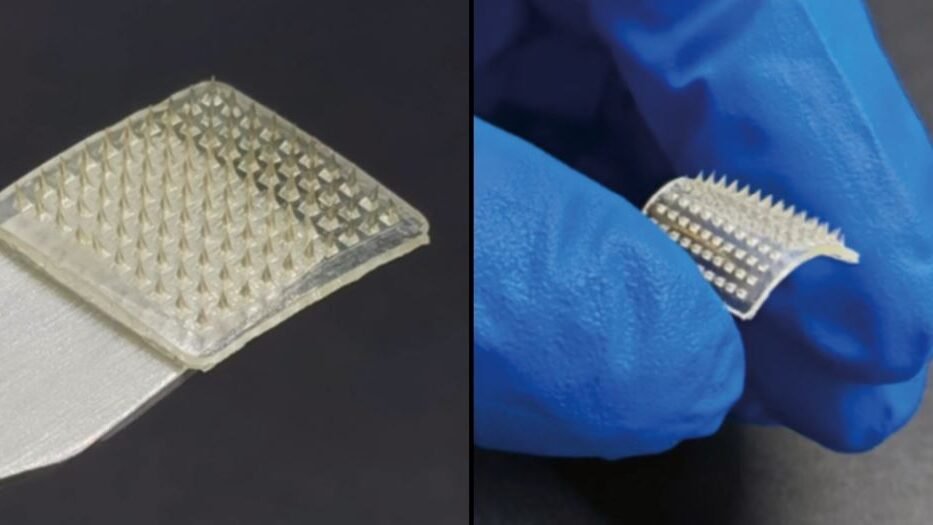
Many chronic conditions require frequent monitoring of biomarkers that cannot be measured easily with conventional wearables. Sweat‑based sensors often struggle with low fluid volume, while blood‑based tests require needles and clinical visits. Researchers at the Hong Kong Polytechnic University developed a wearable microneedle patch that collects interstitial fluid beneath the skin and uses ultrasound to enhance both fluid extraction and biomarker detection. This combination enables continuous, painless monitoring of multiple health indicators and offers an alternative to traditional sampling methods for conditions such as diabetes, cardiovascular disease, and metabolic disorders.
The patch uses an array of microscopic needles that penetrate only the outermost skin layer, avoiding pain receptors and blood vessels. These microneedles draw interstitial fluid into a sensing chamber where biochemical markers can be analyzed. Ultrasound plays a central role by improving the transport of interstitial fluid through the microneedles and increasing the sensitivity of the embedded sensors. When the patch applies low‑intensity ultrasound, it gently agitates the fluid and enhances molecular movement, allowing glucose, lactate, and potassium to reach the sensing region more efficiently. Because interstitial fluid closely reflects blood chemistry, the ultrasound‑assisted system provides clinically relevant measurements without requiring blood collection.
A key innovation is the patch’s ability to operate continuously. Traditional microneedle devices often collect only small fluid samples and cannot sustain long‑term monitoring. The PolyU team engineered a porous structure and fluid‑transport mechanism that works in tandem with ultrasound to maintain steady sampling over extended periods. The sensing components are embedded in a soft, skin‑conforming substrate that allows the patch to bend and stretch with the wearer’s movements. In laboratory testing, the device demonstrated stable performance during motion and maintained accurate readings across a range of biomarker concentrations.
The researchers also developed a wireless system that transmits data to a mobile device for real‑time analysis. This feature supports remote monitoring and could help clinicians track disease progression or treatment response without requiring frequent clinic visits. The ultrasound‑enhanced design allows for future expansion to additional biomarkers, including those relevant to kidney function, inflammation, or electrolyte balance. Because the microneedles are made from biocompatible materials, the patch can be worn safely for extended periods without causing irritation.
The team envisions applications in personalized medicine, sports performance, and early disease detection. By combining painless microneedle sampling with ultrasound‑assisted sensing, the patch provides a continuous, multi‑marker monitoring platform that could help shift routine health assessment from clinics to everyday life. The researchers plan to advance the technology toward clinical trials and explore integration with predictive algorithms that could alert users to emerging health issues.
Article from Hong Kong Polytechnic University: PolyU develops wearable microneedle patch to empower conventional ultrasound for continuous glucose monitoring
Abstract in Science Advances: Augmenting ultrasound for continuous glucose monitoring via a wearable acoustically readable microneedle patch
