
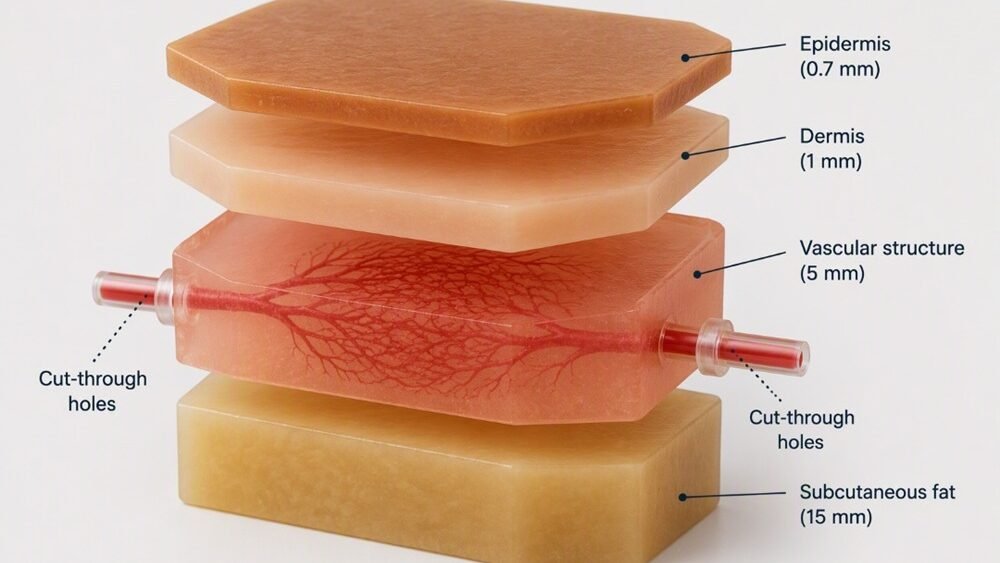
Many medical devices that rely on light, such as pulse oximeters and wearable health sensors, struggle to perform consistently across different skin tones. Darker skin contains more melanin, which absorbs and scatters light, making it harder for optical devices to detect blood‑related signals accurately. This can lead to measurement errors that disproportionately affect people with darker skin, raising concerns about equity and patient safety. Researchers at the VTT Technical Research Centre of Finland developed new multilayer skin‑like test models designed to help engineers evaluate and improve optical devices before they reach patients. These models aim to provide a controlled, repeatable way to test how light interacts with skin of varying pigmentation levels.
The team created realistic “optical phantoms” that mimic the outer skin layer, deeper tissue, and underlying fat. They incorporated pigments to represent lighter, medium, and darker skin tones, covering categories similar to those found in European, South Asian, and African populations. Unlike many existing phantoms, these models include artificial blood vessels connected to a miniature pump that circulates a blood‑like fluid. This feature allows the phantoms to simulate blood flow beneath the skin, which is essential for evaluating devices that measure pulsation, blood oxygenation, or other dynamic signals. The multilayer silicone structures were engineered so that their optical properties closely matched the reflectance patterns observed in real human skin.
To test the phantoms, researchers used hyperspectral imaging, a technique that captures information across many wavelengths of light. They compared regions containing flowing blood‑like fluid with nearby regions lacking vessels. This allowed them to measure how easily blood‑related signals could be detected through skin layers of different pigmentation levels. The results showed a clear trend: in lighter skin models, blood signals were strong and easily detected, while in darker skin models, those signals became progressively harder to identify. In the darkest phantom, the upper pigmented layer significantly reduced the visibility of blood‑related optical signals. These findings highlight how pigmentation affects device performance and demonstrate the value of phantoms that accurately represent diverse skin tones.
The researchers expect these phantoms to help engineers refine optical devices so they perform more reliably for all users. By providing a standardized, repeatable testing platform, the models can reduce reliance on human volunteers and allow developers to evaluate how design choices, wavelengths, and sensor configurations interact with different skin tones. This work supports ongoing efforts to make wearable health technologies more inclusive and more accurate across the full spectrum of human skin.
Article from SPIE: Skin-like test models could help improve medical devices for people of all skin tones
Abstract in Journal of Biomedical Optics: Enhancing skin tone representation in optical vascular phantoms
