
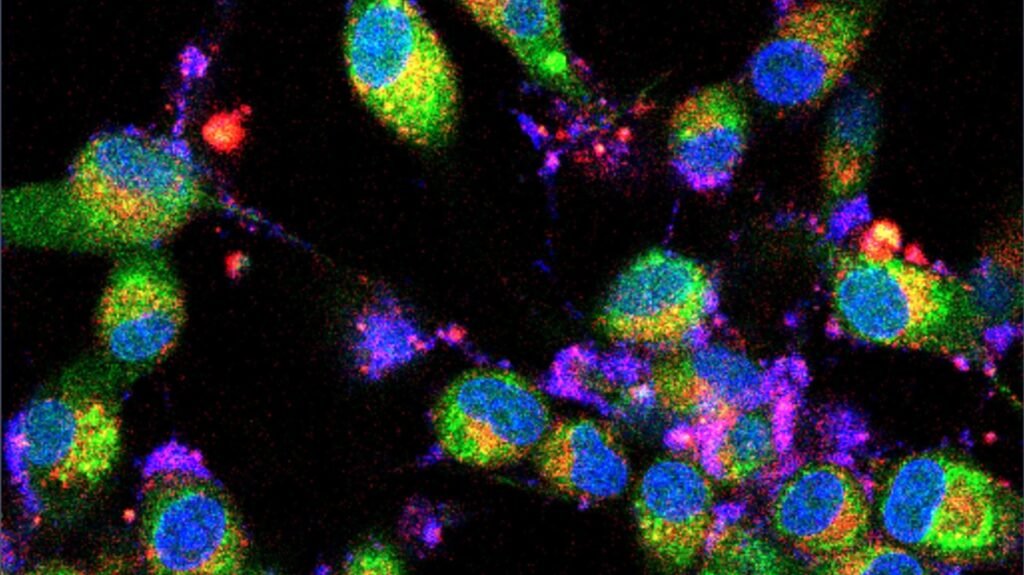
Glioblastoma remains one of the most difficult cancers to treat because its cells infiltrate healthy brain tissue, making complete surgical removal nearly impossible. Even when surgeons remove all visible tumor tissue, microscopic clusters often remain and lead to recurrence. The blood‑brain barrier further complicates treatment by limiting how well drugs and radiation reach the tumor site. Researchers at the University of Technology Sydney and collaborating institutions developed a multifunctional nanozyme platform designed to address both challenges using a single material activated by near‑infrared light.
The platform is built from an ultrathin two‑dimensional sheet engineered with isolated platinum atoms placed individually using a fabrication technique adapted from the semiconductor industry. This atomic‑scale design gives the material two switchable functions: high‑resolution imaging during surgery and targeted phototherapy afterward. A fluorescent dye attached to the sheet glows under near‑infrared light, allowing surgeons to visualize tumor cell clusters as small as forty‑four micrometers, a level of precision beyond current clinical imaging tools. A targeting molecule helps the material cross the blood‑brain barrier and accumulate specifically in glioma cells, improving accuracy during tumor removal.
After surgery, the same material is reintroduced into the surgical cavity and activated again with the same wavelength of light. In this second mode, the platinum atoms convert the tumor’s hydrogen peroxide into oxygen, counteracting the low‑oxygen environment that normally protects cancer cells from treatment. At the same time, the near‑infrared light generates heat and reactive molecules that destroy residual cancer cells left behind after surgery. This dual‑function approach allows surgeons to remove more tumor tissue safely and then eliminate microscopic disease that would otherwise lead to recurrence.
In mouse models of glioblastoma, the nanozyme platform suppressed tumor regrowth and achieved one hundred percent survival at sixty days, demonstrating its potential to improve outcomes for a cancer with a historically poor prognosis. The researchers emphasize that combining surgical imaging and postoperative therapy into a single material could reduce treatment complexity and improve precision. The approach may also inspire future multifunctional tools that integrate imaging, targeting, and therapy for other hard‑to‑treat cancers.
Article from University of Technology Sydney: A ‘Double-Punch’ Approach to Tackling Brain Cancer
Abstract in Science Translational Medicine: Spatiotemporal-switchable 2D NIR-II single-atom nanozyme for single-cell–level surgical navigation and glioblastoma phototherapy
