
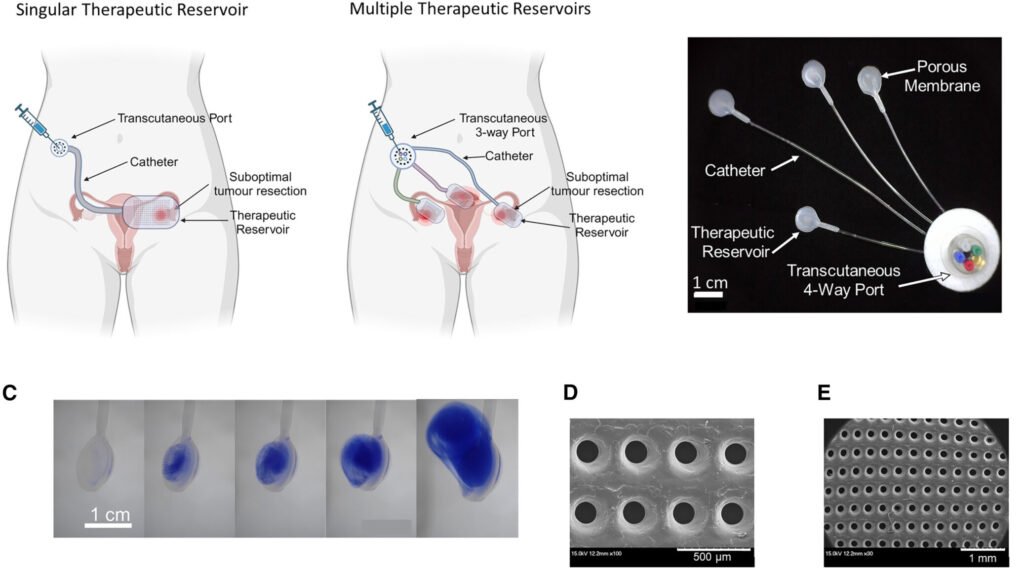
Ovarian cancer is difficult to treat because it often spreads throughout the peritoneal cavity, making it challenging to deliver therapy precisely where it is needed. Standard approaches rely on surgery and systemic treatments that struggle to reach microscopic disease and cannot be easily repeated without invasive procedures. Researchers at the University of Galway and collaborating institutions designed a replenishable implant that sits inside the peritoneal cavity and delivers therapy directly to the tumor environment while also monitoring how the disease responds.
The implant is made from a flexible, porous biomaterial that conforms naturally to the body’s internal contours. It connects to an external port through the skin, allowing clinicians to refill it with therapeutic agents as often as needed without additional surgery. This design addresses a major limitation of previous intraperitoneal delivery tools, which were typically repurposed catheters not optimized for long‑term use. The porous membrane enables therapeutic cargo to diffuse gently and evenly into surrounding tissue, reducing mechanical complications and improving local drug distribution. Preclinical studies showed that the implant remained fully functional for up to seventy days with no implant‑related complications and provided significantly better tumor control than conventional treatments.
The device is engineered to support next‑generation therapies, including living cell treatments, which are among the most challenging to deliver reliably. In testing, the implant enabled repeated administration of therapeutic agents directly to the tumor site, demonstrating the potential for more precise and sustained treatment. Because ovarian cancer is often diagnosed at late stages and current methods cannot reliably detect recurrence, the ability to deliver therapy locally and repeatedly represents an important advance. The implant’s design also allows for future adaptation to deliver a wide range of cell‑based or non‑cell‑based therapies.
Researchers emphasized that localized delivery is known to be more effective for ovarian cancer, but existing tools were not built for repeated, precise administration. By creating a device that can be replenished without surgery and that maintains stable function over extended periods, the team aims to improve patient retention, reduce procedural burden, and enhance therapeutic outcomes. The approach could eventually support personalized treatment strategies for ovarian cancer and other intra‑abdominal cancers that benefit from targeted, sustained therapy.
Article from the University of Galway: Researchers design implant that fights ovarian cancer from the inside
Abstract in Device: A replenishable peritoneal implant for localized delivery and peritoneal fluid sampling in ovarian cancer
