
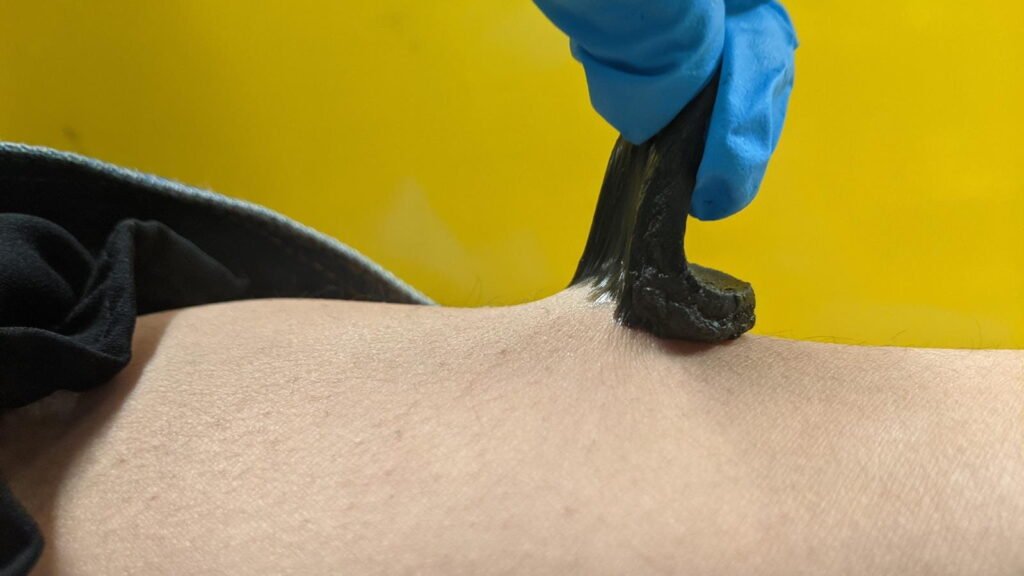
Many wearable health sensors struggle to maintain reliable contact with the skin, especially when sweat, hair, bending, or stretching interfere with the electrode interface. These interruptions can distort biological signals and reduce the accuracy of devices used for monitoring chronic conditions. Researchers at Drexel University and Penn State University developed a new graphene‑reinforced hydrogel designed to solve this problem by creating a soft, breathable, adhesive interface that stays attached even under demanding real‑world conditions.
The hydrogel is engineered to be ultrasoft, highly stretchable, and conformal. It incorporates porous laser‑induced graphene and reduced graphene oxide flakes, which form an internal network that allows sweat to pass through the material instead of accumulating beneath it. This prevents moisture buildup that typically weakens sensor performance. The gel also uses polydopamine, a bio‑inspired adhesive, to maintain strong attachment through hair and sweat while preserving conductivity during movement.
A key innovation is the hydrogel’s pH‑tunable manufacturing process. By adjusting the precursor solution’s pH, researchers can delay gelation inside a syringe, allowing the material to be dispensed smoothly onto the skin before it sets. This enables custom shapes, patterns, and electrode designs that conform precisely to different body areas. Once applied, the gel forms a stable, breathable interface that can be peeled off and reapplied multiple times without losing performance.
Testing showed that the material stretches up to roughly eighty times its original length while maintaining low skin‑contact impedance and high signal quality. It supports electrophysiological measurements such as electrocardiography, electro‑oculography, and electrodermal activity, even during bending, sweating, and motion. In demonstration studies, the hydrogel enabled multi‑sensor arrays to track physiological changes related to anxiety by monitoring blinking, sweat activity, and heart signals simultaneously.
The work positions this graphene hydrogel as a promising foundation for next‑generation wearable biosensors. Its combination of breathability, adhesion, stretchability, and reusability addresses one of the biggest limitations in real‑world wearable monitoring: keeping sensors reliably connected to the skin during everyday life.
Article from Drexel University: Soft, Sticky, Stretchable Biosensors Make a Better Connection
Abstract in Science Advances: Ultrasoft, adhesive, pH-tunable hydrogel based on in situ functionalized laser-induced graphene for through-hair concurrent biosensing
