
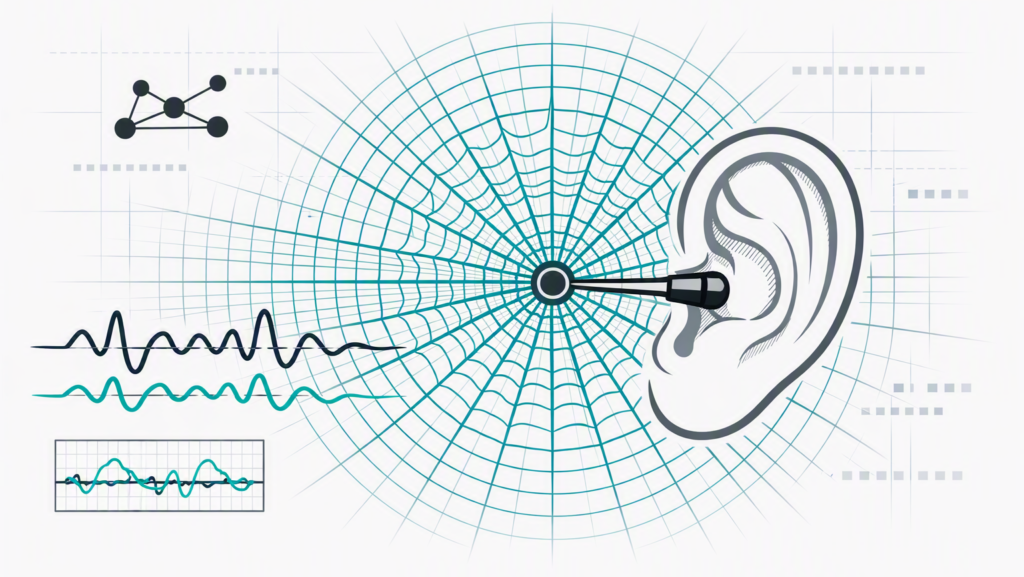
Hearing problems often go undetected until they become more serious, in part because current diagnostic tools can struggle to measure the faint signals produced by a healthy inner ear. Researchers at Binghamton University are developing a new ear‑canal probe that aims to improve early diagnosis by measuring these signals more accurately. Their work is inspired by how spiders sense sound through the motion of their webs, a biological strategy that detects air movement rather than pressure. This insight is helping engineers rethink how medical microphones should work.
The inner ear produces extremely quiet sounds called otoacoustic emissions. These emissions disappear when the cochlea is damaged, making them a valuable indicator of hearing health. Conventional microphones measure sound pressure, but sound also creates air movement, known as particle velocity. The research team is building a dual‑sensing probe that can detect both pressure and particle velocity inside the ear canal. This approach could capture otoacoustic emissions more reliably, especially in cases where traditional microphones struggle to pick up such faint signals.
The project builds on earlier work studying how insects and spiders detect sound. Spiders do not rely on eardrums. Instead, they sense the motion of air through vibrations in their webs. This concept inspired a new class of flow microphones that detect particle velocity with high fidelity. Experiments showed that spider‑silk‑inspired sensing elements could respond to sound across a wide frequency range with exceptional accuracy.
The new ear probe will incorporate these bio‑inspired sensing principles into a medical device. If successful, the technology could help millions of people receive earlier and more accurate hearing assessments. Because the probe measures both pressure and air motion, it may detect subtle changes in cochlear function that current tools miss, offering clinicians better feedback for diagnosis and treatment.
Article from Binghampton University: New ear probe to detect hearing issues is based on how spiders ‘hear’ through their webs
