
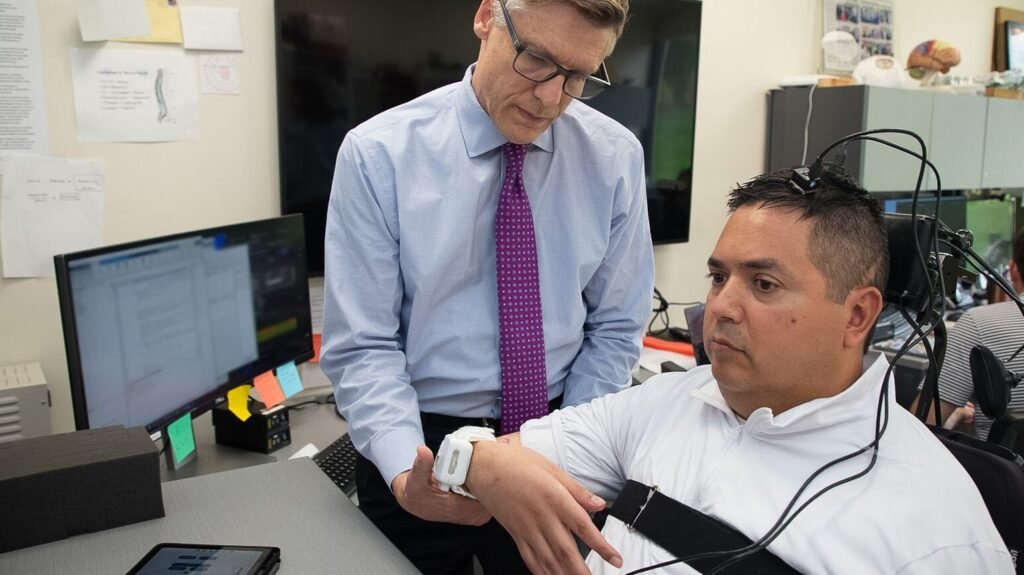
Severe spinal cord injuries often leave people without any ability to move or feel below the level of damage, and current treatments offer limited recovery. Researchers at the Feinstein Institutes for Medical Research have developed a double neural bypass system that is showing how advanced brain–computer interfaces and targeted electrical stimulation can help restore both movement and sensation in a person with complete tetraplegia.
The technology combines implanted microelectrode arrays in the brain with artificial intelligence and precisely targeted stimulation of the spinal cord and the somatosensory cortex. The system reads the participant’s intention to move from the motor cortex and uses those signals to activate the muscles of the arm and hand. At the same time, stimulation of the somatosensory cortex helps restore a sense of touch. This dual approach allows the participant to move his own hand rather than relying on an external robotic device. Over three years of clinical testing, the participant regained the ability to feed himself, drink from a cup and perform everyday tasks that had been impossible since his injury. He also recovered meaningful sensation in his wrist and hand.
One of the most striking findings is that some of the improvements persisted even when the system was turned off. The participant maintained increased arm strength and continued to experience restored sensation for months after stimulation ended. These lasting gains suggest that the double neural bypass promotes neuroplasticity, helping the nervous system form new pathways around the injury. This represents a shift from simply bypassing damaged tissue to actively retraining the nervous system to recover lost functions.
The clinical trial also showed that the system could reliably interpret intended hand movements for more than five months without repeated retraining. This stability is important for future clinical use, as it reduces the burden on both patients and clinicians. While the technology is still highly specialized and requires trained staff to operate, researchers believe it could eventually help many people living with paralysis. They note that further testing in additional participants will be needed to understand how widely the approach can be applied.
By restoring both movement and touch, the double neural bypass offers a new path forward for treating complete spinal cord injuries and demonstrates how advanced neurotechnology can help people regain independence and reconnect with their daily lives.
Take a look at this video below sharing the technology from the participant’s perspective:
Article from the Feinstein Institutes for Medical Research: Feinstein Institutes technology that restores movement and sensation after paralysis featured in Nature Medicine
Abstract in Nature Medicine: A neuroprosthesis for restoring hand movement and sensation in a person with complete tetraplegia
