
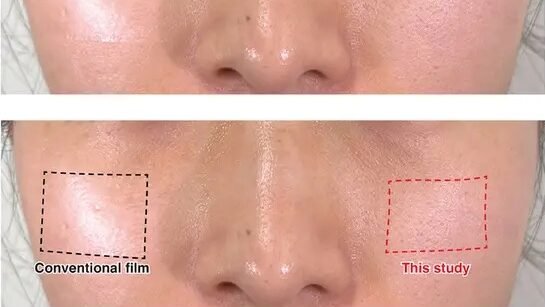
Many wearable health sensors are uncomfortable, noticeable or distracting, especially when placed on the face. These devices can make people self‑conscious and even change the very signals they are meant to measure. Researchers at the University of Tokyo have developed ultrathin, stretchable skin sensors that solve this problem by becoming effectively invisible when worn. Their goal is to allow people to monitor important biological signals naturally, without feeling watched or altered by the presence of a device.
The new sensors are built on an elastic film only about 200 nanometers thick, paired with transparent conductive nanowires. This combination allows the device to blend seamlessly into the skin, matching its appearance and texture. Because the film is so thin and flexible, it avoids the glossy reflections and raised edges that make typical wearable electronics easy to spot. In testing, neither the people wearing the sensors nor outside observers could reliably detect them by sight or touch. The sensors also remained comfortable and breathable across different skin tones and facial features.
Despite being nearly invisible, the sensors still capture high‑quality biosignals. The research team successfully recorded eye‑movement signals, facial muscle activity and brain‑wave patterns using the new electrodes. These measurements are important for health monitoring, communication technologies and human‑machine interaction. In several cases, the signal quality was better than that of conventional gel electrodes because the ultrathin film reduces skin impedance, improving electrical contact without adhesives or bulky materials.
The researchers emphasize that appearance matters in wearable technology. Traditional facial electrodes can change how people behave socially, create discomfort and influence emotional expression. These effects, known as appearance artifacts, can distort the data collected. By making sensors that disappear into the background, the team hopes to support more natural monitoring in daily life. Senior author Naoji Matsuhisa explains that people should be able to wear sensors without feeling judged or uncomfortable, and these ultrathin devices are designed to meet that need.
This work represents a step toward wearables that integrate seamlessly into everyday routines. As sensors become thinner, softer and more discreet, they may help expand continuous health monitoring, support new communication tools and reduce the stigma associated with visible medical devices.
EurekAlert News Release: The invisible wearable: New skin sensors revolutionizing health monitoring
Abtract in Science Advances: Reduction of appearance artifacts in wearable on-skin electronics
