
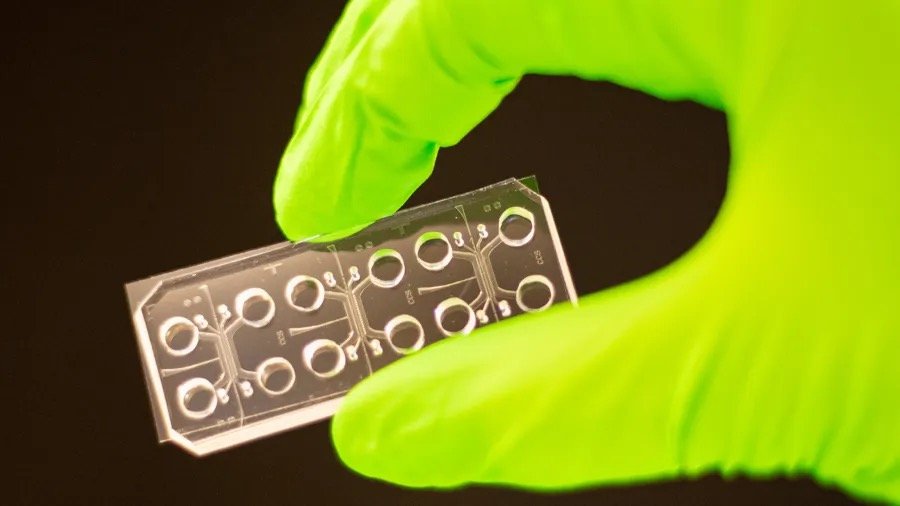
A tumor is made up of more than cancer cells. In the body, solid tumors grow in close contact with blood vessels, nerves, and surrounding tissue, and these interactions help determine why a tumor grows, spreads, causes pain, or resists treatment. Studying them often means doing research on animals or testing potential drugs in people, and researchers need models that can reproduce how a tumor interacts with its surroundings. Researchers at Linköping University in Sweden have developed an organ-on-chip model of head and neck cancer that does this on a transparent plate about the size of a postage stamp, letting them study these complex interactions under highly controlled conditions.
The research team built the model in three steps. In the body, cells sit within a network of proteins and carbohydrates called the extracellular matrix. The researchers first created a material to mimic this matrix using hyaluronic acid, collagen, and laminins, all key components of the body’s own matrix. They found that the makeup of the matrix dramatically changed how cancer cells behaved and how they responded to chemotherapy, showing that this choice is an important factor in models designed to imitate human disease.
Next, the team added structures that function like blood vessels. Blood vessels feed tumors with oxygen and nutrients, are the most common route for cancer to spread to other parts of the body, and carry cancer drugs to tumors. On the chip, cancer cells sensed a nearby vessel, moved rapidly toward it, and invaded it, the first step in tumor spread. Their behavior differed greatly depending on the surrounding material. When the researchers delivered the chemotherapy drug cisplatin, commonly used for this type of cancer, through the vessel structure, the matrix material also affected how well the drug killed cancer cells.
Finally, the researchers used stem cells to recreate trigeminal ganglia, the starting point of the nerves involved in sensation and pain in the mouth and face. Within a few days, the nerves had grown around the tumors. Tumors in contact with nerves were less likely to invade blood vessels but grew larger. This is especially relevant in head and neck cancer, where nerves help regulate how a tumor behaves and how aggressive it is, and also play a role in cancer-related pain.
Looking ahead, the researchers believe the model could be adapted to other solid tumor types where interactions with surrounding structures and tissues matter. Beyond helping scientists better understand how cancer behaves and responds to its surroundings, the approach could eventually be useful for drug screening and for testing how tumors respond to treatment.
Article from Linköping University: Organ-on-chip shows how cancer interacts with its surroundings
Abstract in PNAS: An innervated and vascularized HNSCC-on-a-chip model built on defined and tunable engineered extracellular matrices
