
The skin is remarkably good at keeping things out of the body, which becomes a problem when medicine needs to get in. A pill taken for a skin condition must pass through the stomach and bloodstream and travel throughout the body just to reach the skin. Applying a drug directly to the skin seems simpler, but the skin’s outer layer blocks most of the medicines meant to treat it. Microneedle patches can help drugs get through, but they work best on small areas and are impractical for conditions such as eczema and psoriasis, which can cover broad or irregularly shaped parts of the body. Researchers at the Georgia Institute of Technology have developed microscopic particles, studded with tiny needles, that can be mixed into creams and gels to help medicine pass through the skin wherever it is applied.
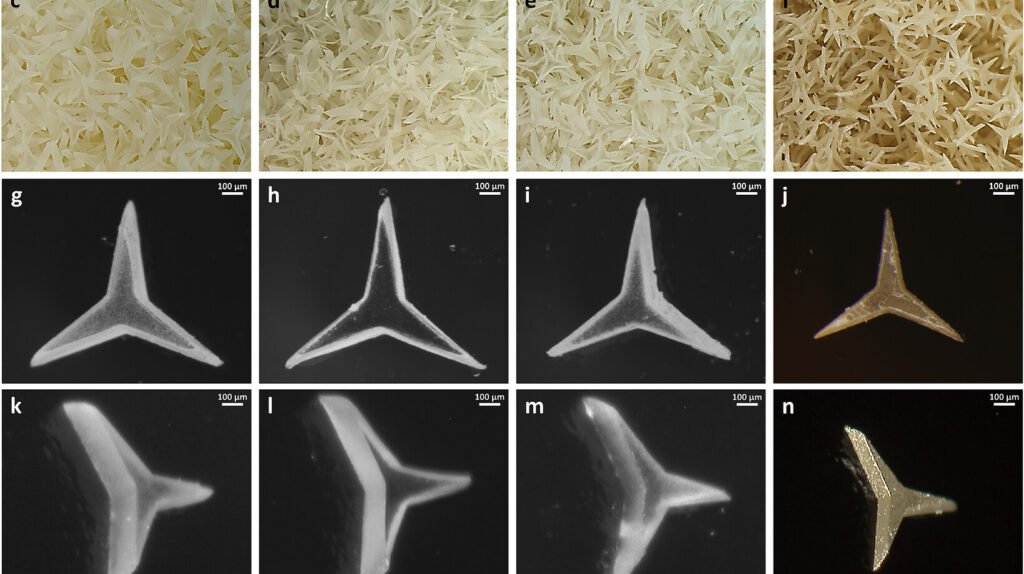
The researchers call them “STAR” particles because their microneedles stick out like the points of a star, giving them an appearance similar to a tiny porcupine. When a cream or gel containing the particles is rubbed onto the skin, the particles roll and slide around, poking microscopic holes in the skin’s outer barrier. These openings allow the medicine in the cream or gel to be absorbed over time.
An earlier version of the particles, made from a ceramic material called titania, was tested in a small human study. The particles helped a numbing medication take effect faster and reduce sensation more than the medication used alone. In separate tolerability tests, the particles caused only mild redness that faded, and participants described a tingling feeling rather than pain or discomfort. Titania is safe, but it is not biodegradable. Although no evidence shows the particles cause harm, it was unclear where they might end up after use, whether in someone’s eye, on a child, or in the environment.
To address this, the research team redesigned the particles using three materials that break down after use: a biodegradable plastic that can be made from corn and is used in dissolvable stitches, a material based on cellulose, a major component of plants, and an additive often found in candy and other foods. All three created the tiny openings needed to help substances pass through the skin. The strongest result involved a skincare ingredient called copper tripeptide-1, with nearly 37 times as much entering the skin compared with no particles. The particles also showed good results with methotrexate, a psoriasis treatment, and tacrolimus, an eczema treatment. The study measured how much drug entered the skin rather than treatment results, and the biodegradable particles have not yet been tested in people.
Looking ahead, the researchers believe that delivering drugs directly to the skin could reduce side effects that occur when medicines circulate throughout the body, possibly allowing some potentially useful skin disease drugs that have been set aside because of those side effects to be used. The particles might also one day deliver anti-aging treatments without injections or harsher procedures, though such cosmetic uses were not evaluated in this study. For patients, using the particles could feel much like applying an ordinary lotion, with only a slight tingle.
Article from Georgia Tech: Microscopic “Porcupines” Poke a Path for Improved Skin Treatments
Abstract in Advanced Healthcare Materials: Water-Soluble, Enzyme-Degradable, and Hydrolyzable STAR Particles for Enhanced Drug Delivery to Skin
