
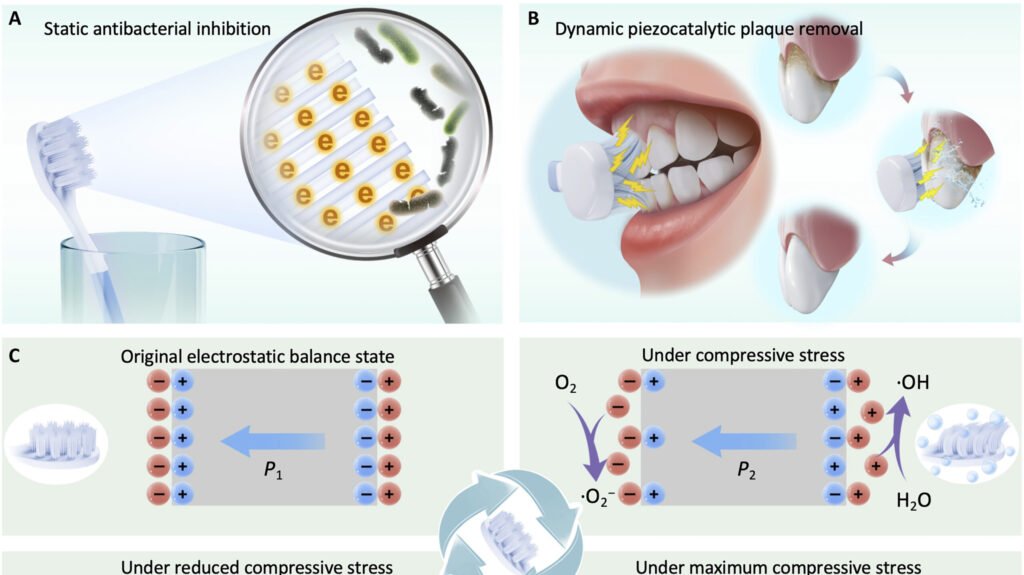
Brushing is the most common way people care for their teeth each day, yet the basic toothbrush has changed little beyond its scrubbing action in more than a thousand years. Dental plaque is a complex film of bacteria protected by a sticky matrix, which makes it hard for brushing alone to clear bacteria from deep layers and the spaces between teeth. Brushing also leaves no lasting protection on the tooth surface, so bacteria can recover and recolonize within hours. Antibacterial toothbrushes that add chemical agents such as metal ions to their bristles may not stay effective over time, and ionic toothbrushes rely on batteries. Researchers at Peking University Hospital of Stomatology have developed a battery-free toothbrush whose bristles generate their own electrical charge to fight plaque-causing bacteria.
The bristles are made from polyvinylidene fluoride, a piezoelectric material that produces an electrical charge when it bends. As the bristles flex during brushing, this charge triggers chemical reactions that create reactive oxygen species, highly reactive molecules that damage bacterial membranes. Even at rest, the bristles carry a surface charge that helps keep bacteria from clinging to them.
In lab tests, the bristles killed about 46 to 53 percent of Streptococcus mutans, a bacterium linked to cavities, compared with about 9 percent for nylon bristles. Against Porphyromonas gingivalis, a bacterium linked to gum disease, they killed about 57 to 78 percent, compared with about 8 percent for nylon. The toothbrushes removed more than 99 percent of plaque grown from human samples on cow teeth, outperforming nylon brushes. They also met national toothbrush standards, held up through three months of simulated use without damaging tooth enamel, and showed little toxicity to cells.
The research team then tested the toothbrushes in a three-month trial with 115 adults who had gum inflammation or cavities. Participants were randomly assigned either one of two versions of the new toothbrush or a conventional nylon toothbrush. Those using the new toothbrushes showed significant reductions in plaque, gum inflammation, and bleeding, with plaque improving first and gum health following. Genetic analysis of plaque samples showed that harmful bacteria decreased, while beneficial bacteria such as Lactobacillus rhamnosus and Streptococcus salivarius increased. The researchers found that harmful oral bacteria have more fragile membranes and weaker defenses against oxidative damage, so the reactive molecules disrupted their membrane transport systems while leaving beneficial bacteria largely unaffected.
The research team notes that its lab experiments did not fully reproduce the brief, intermittent nature of real brushing, and that future studies should use models that better mimic it. They also plan to compare the toothbrushes with commercially available electric, sonic, and antimicrobial-coated toothbrushes, and to carry out longer-term follow-ups to confirm the lasting benefits for tooth health.
EurekAlert! Press Release: Toothbrush produces electricity to battle plaque-making bacteria
Abstract in Science Advances: Self-charged toothbrush facilitates tooth healthcare maintenance
