
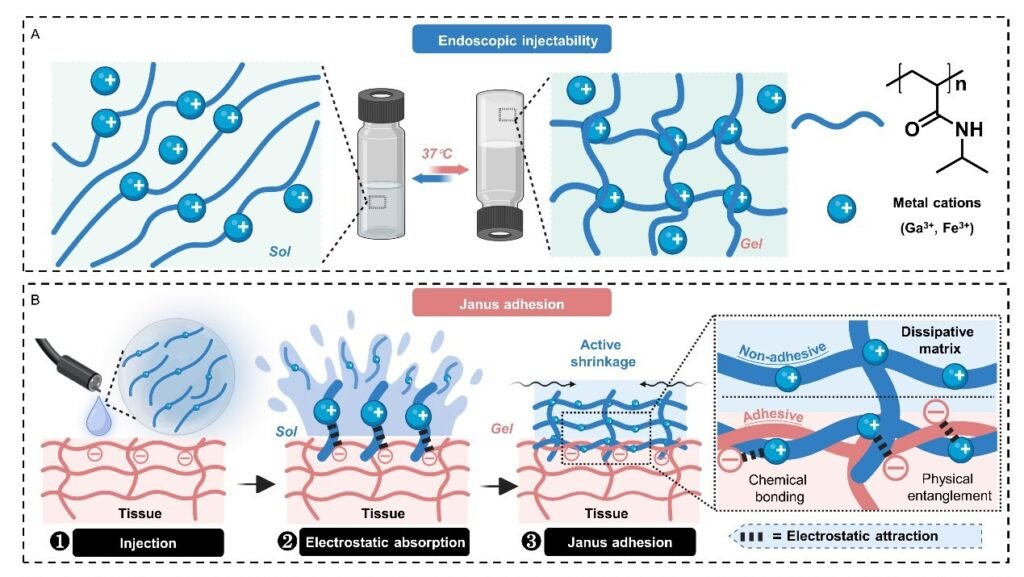
Gastrointestinal fistulas are abnormal passages that form between the digestive tract and another organ or tissue. They are a common complication of surgery, trauma, inflammatory diseases, and cancerous tumors, and severe cases can be life-threatening. Doctors often treat them endoscopically, but current methods have drawbacks. Stents can migrate out of place, fistulas closed with titanium clips can come back, and endoscopic suturing is technically difficult. Unwanted tissue adhesions after treatment add further complications. Researchers at the Institute of Process Engineering of the Chinese Academy of Sciences have developed a sealant inspired by slugs that can be injected through a standard endoscope and has effectively sealed gastrointestinal fistulas in animal models.
The idea came from slugs living in humid jungles, which secrete a defensive mucus strong enough to stick tree frogs to branches. This mucus is rich in positively charged proteins that grip wet tissue through electrical attraction and physical entanglement, and these proteins change from a liquid into a gel in response to metal ions and environmental conditions. Mimicking this, the research team combined a temperature-sensitive polymer with gallium ions. At room temperature, the sealant is a clear, flowing liquid that passes easily through a fine needle and a standard endoscope channel. Once it reaches body temperature, it turns into a gel within about 30 seconds.
The gel’s tissue-facing side sticks firmly to tissue, while the side facing the inside of the digestive tract stays nonstick. Injection, adhesion, and contraction all happen in a single step. This solves a problem with earlier injectable hydrogels, since the gel does not need to have different sticky and nonstick sides before or during injection. In lab tests, the adhesive side was nearly 100 times stronger than the nonstick side, and in a pig stomach tested outside the body, the gel sealed a 10-millimeter hole without leaking.
At body temperature, the gel also pushes out water. As a result, its adhesion strength and resistance to bursting actually increased after soaking in simulated stomach acid, while those of commercial fibrin glue dropped sharply. The gel shrank by about half in surface area, creating an inward pulling force that keeps the fistula opening from widening, a problem that occurs with materials that swell. The gallium ions also disrupt how bacteria use iron, inhibiting about 98.6 percent of Escherichia coli and Staphylococcus aureus. Safety evaluations, including tests for cell toxicity, damage to blood cells, and long-term effects in the body, were all favorable.
In rats with gastric fistulas, the death rate after treatment was 3.3 percent with the new sealant, compared with 6.7 percent for sutures and 56.7 percent for fibrin glue. Rats treated with the sealant showed almost no tissue adhesions and near-complete recovery of the stomach wall by day 21, while the other groups developed severe adhesions. In pigs, the research team applied the sealant endoscopically to a 20-millimeter stomach fistula. After 14 days, the fistula had fully closed with smooth lining tissue and no leftover material, and the repair was better than with titanium clips.
Because these results come from animal studies, further research is needed to confirm the sealant’s safety and effectiveness in people. The research team plans to study how the body processes and clears gallium in large animals and how changes in digestive tract acidity affect the gel’s breakdown. They also intend to improve the catheter delivery system and manufacturing process to move the sealant toward clinical use. The approach could also inform the repair of fistulas in other organs and the design of next-generation sealing materials for minimally invasive surgery.
Article from the Chinese Academy of Sciences: Researchers Develop Slug-Inspired Hydrogel for Endoscopic Repair of Gastrointestinal Fistulas
Abstract in Nature Biomedical Engineering: A single-step injectable Janus-adhesive hydrogel for endoscopic gastrointestinal fistula repair
