
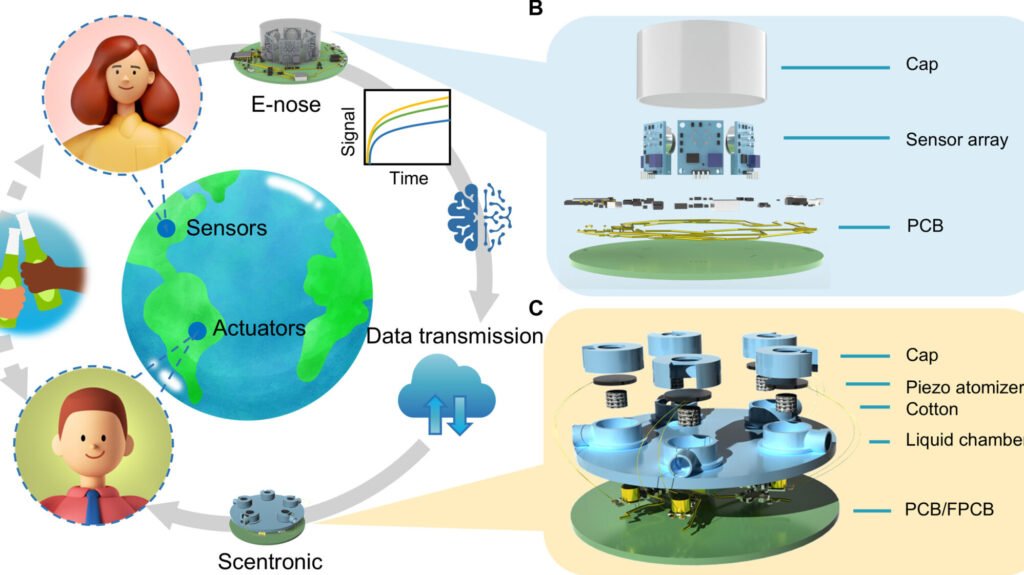
Our sense of smell helps us find our way through the world and plays a key role in perception, flavor, and emotion, yet it is notoriously hard to recreate digitally. Losing it is linked to many neurological diseases and infections. Interfaces that connect people with machines, used in fields ranging from medical research to online gaming, mostly rely on touch, sound, and sight, leaving smell out of the picture. Researchers at The Ohio State University have developed a system that detects and analyzes odors and releases scents through wearable devices, a step toward bringing smell into digital experiences and toward technology that may help scientists explore sensory loss.
The system pairs an electronic nose, powered by artificial intelligence, that detects and analyzes odors with a wearable scent release system called Scentronic. Scentronic uses machine learning to classify data in real time and is designed to deliver smells accurately without the user having to operate it by hand.
The study focused on five food scents: coffee, beer, red wine, orange, and chocolate cake. In field testing, participants correctly identified individual odors about 73 percent of the time and pairs of scents about 71 percent of the time. The team also found that some people were more sensitive to certain odors than others, and that even easily distinguished scents varied widely in perceived intensity from person to person. When Scentronic was combined with interfaces that can generate taste, the results showed that programmable, cost-effective scent delivery systems can create engaging multisensory experiences.
Although Scentronic is still a prototype, its flexible design allowed the researchers to build several versions. One is a wristband that users can raise to their nose when they want to smell a scent. Another is a necklace with five scent channels lined up like pearls on a string, each opening only after it receives a signal. The ease of adapting the system to these designs shows its potential to enhance extended reality experiences beyond sight and sound.
Looking ahead, the researchers see many possible real-world uses, including assistive technologies, virtual training environments, and sensory aids in medical settings that could reduce the need for frequent clinic visits, improve patient comfort, and support timely, personalized care. They also see value in technologies that first help reveal how the sense of smell works and then try to reconstruct it. Next steps include testing ways to build the devices into everyday accessories, such as watches and other smart jewelry, with the long-term goal of compact, personalized devices.
Article from Ohio State: New tech passes the smell test
Abstract in Science Advances: Scentronic: An artificial intelligence–assisted olfactory interface for remote odor sharing and transmission
