
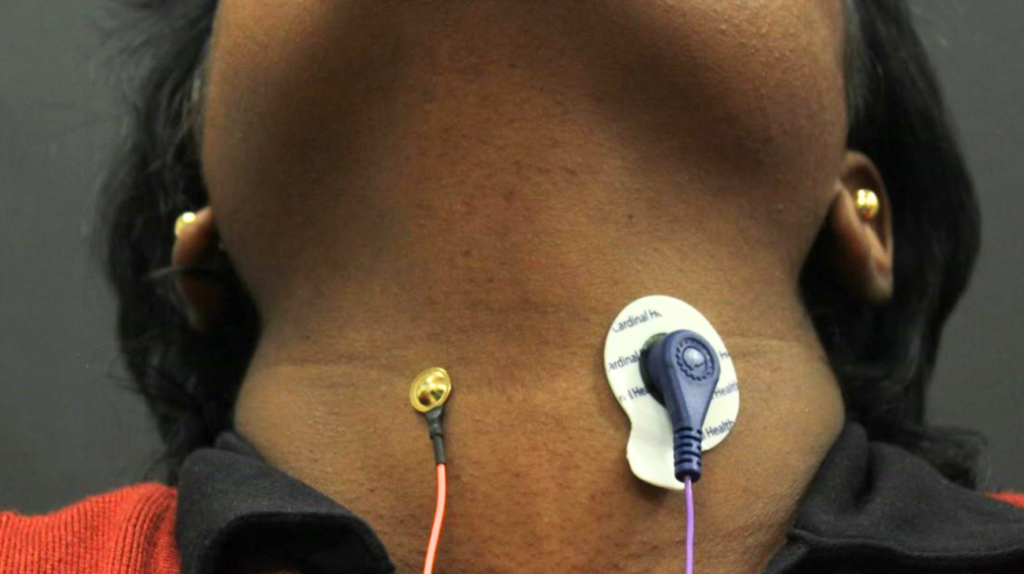
Rebuilding strength in the muscles used for speaking often depends on exercises that patients with voice disorders must practice largely on their own. Speech pathologists can prescribe muscle-strengthening routines, but they may see patients for only 30 minutes a week or even once a month, leaving patients with no way to tell whether they are using the right muscles correctly while practicing at home. Researchers at McGill University have developed a putty-like electrode that molds to the skin and could help close that gap by improving the treatment and monitoring of voice disorders and upper airway diseases.
Sensors that measure muscle activity, a technique called electromyography, work well on large areas such as the arms and legs. Designing practical versions for the neck has been difficult because the muscles there are small and the skin surface is highly curved. Most commercial sensors also rely on a gel to stick to the skin and carry physiological signals. These wet sensors can become messy over time and eventually dry out, which adds noise to the signal.
The new electrode is made from a soft, silicone-based putty that conducts electricity like a metal thanks to tiny silver wires embedded inside it. Because the material is dry, it can be pressed closely against the skin, leaving very little air between the skin and the sensor to interfere with the signal. Surprisingly, stretching the putty actually improves its ability to conduct electricity, because the wires rearrange themselves as it stretches and help keep the current flowing.
To test the device, the research team shaped the putty into neck electrodes and recorded muscle activity while three volunteers performed vocal tasks designed to tire the muscles. This allowed the team to check whether the electrode could still pick up weak signals from fatigued muscles. In this proof-of-concept study, the electrode matched a standard clinical electrode for noise and stability while recording clean signals from small neck muscles, an area where standard electrodes struggle.
The researchers note that the study was not a clinical trial, and larger studies and regulatory approval will be needed before the device is ready for clinical use. In the future, the electrode could serve as an at-home biofeedback tool, letting patients see whether they are using their muscles correctly during exercises. The team also sees potential for tracking breathing, swallowing, and speaking during rehabilitation after a stroke or in neurodegenerative diseases such as Parkinson’s, and more broadly for making wearable health sensors more comfortable, practical, and effective.
Article from McGill University: A putty-like electrode could improve vocal rehabilitation
Abstract in Science Advances: Mechanoadaptive nanowire viscoplastic composites with strain-enhanced conductivity for reprocessable bioelectronic interfaces
