
For decades, scientists have been developing neuroprosthetic limbs, which use signals from the muscles left after an amputation to guide an artificial limb. Information about how far a muscle stretches, how fast it moves, and how strongly it activates can be fed into the limb’s control system, helping people with leg amputations walk more naturally and helping those with arm amputations handle objects more effectively. These devices have traditionally relied on electrodes placed on the skin to measure muscle activity, but those readings have not been reliable enough to keep someone safe while walking on a neuroprosthetic leg. Researchers at the Massachusetts Institute of Technology (MIT) have now shown that tiny magnetic beads implanted in muscle can track its movement accurately, which could give people with certain types of amputations better control of their prosthetic limbs.
Skin electrodes detect the electrical activity of the muscle underneath, and those readings are converted into estimates of how much the muscle is contracting. This method, called electromyography, has several weaknesses. The electrical signal does not perfectly reflect what the muscle is physically doing. When a muscle is held at a fixed length for a few seconds, for example, the signal fades. The electrodes can also pick up signals from neighboring muscles, and sweat can interfere with detection. The research team has previously used electrodes implanted directly in muscle to get more accurate readings, but they have also been working on a less invasive option.
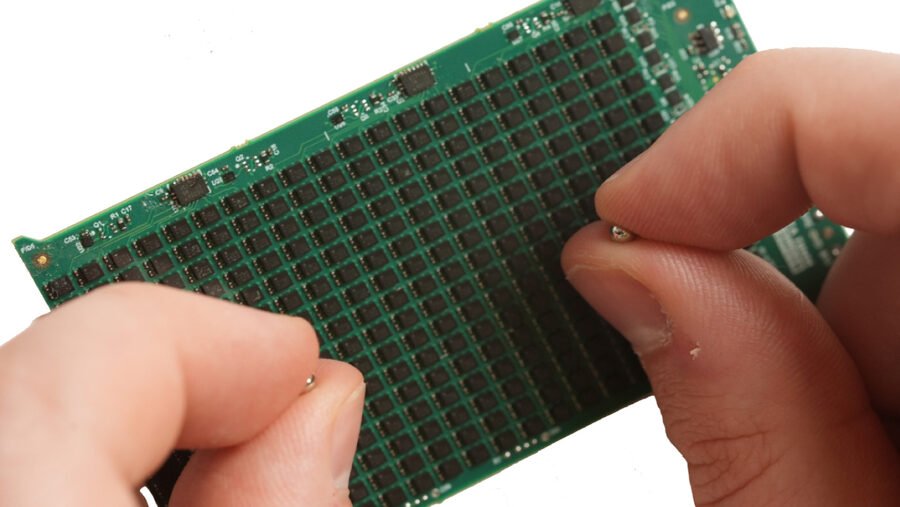
That option, called magnetomicrometry, places pairs of magnets inside a muscle. As the muscle contracts or stretches, sensors on the skin measure the changing distance between the magnets, revealing the muscle’s length and speed. Each bead is 3 millimeters wide, about the size of a sesame seed, and is made from an alloy of neodymium, iron, and boron, coated with gold and a polymer to make it safe inside the body. A custom sensor worn over the skin can read the magnets from as deep as 6 centimeters.
The team had already demonstrated the technique in animals and has now tested it in three people with below-knee amputations. All three had undergone a surgical procedure that reconnects muscle pairs in the residual limb so they continue to work together, giving the wearer a sense of limb position that helps them decide how to move the prosthesis. Surgeons at Brigham and Women’s Hospital implanted magnets in up to four ankle muscles in each participant, along with electrodes in the same muscles. This allowed the researchers to compare magnetic tracking with both implanted and skin-surface electromyography.
Without wearing a prosthesis, participants used their muscle movements to steer a cursor to targets on a screen, with the cursor standing in for the movements they would control on a robotic ankle and foot. The results suggest that the magnetic approach provides more accurate and stable control than either type of electrode. Because only two beads are needed per muscle, the researchers say the method is minimally invasive and could reach more people.
The research team is now running a larger study to evaluate how well people can control actual prosthetic limbs using the magnetic measurements. They hope the more accurate tracking will open the door to commercial development of neuroprosthetic limbs.
Here’s a video showing how the magnetic beads are wirelessly tracked:
Article from MIT: Magnetic sensors track muscle movement, for better prosthetic limb control
Abstract from Nature Sensors: A wireless magnetic implant system for continuous neuromuscular sensing
