
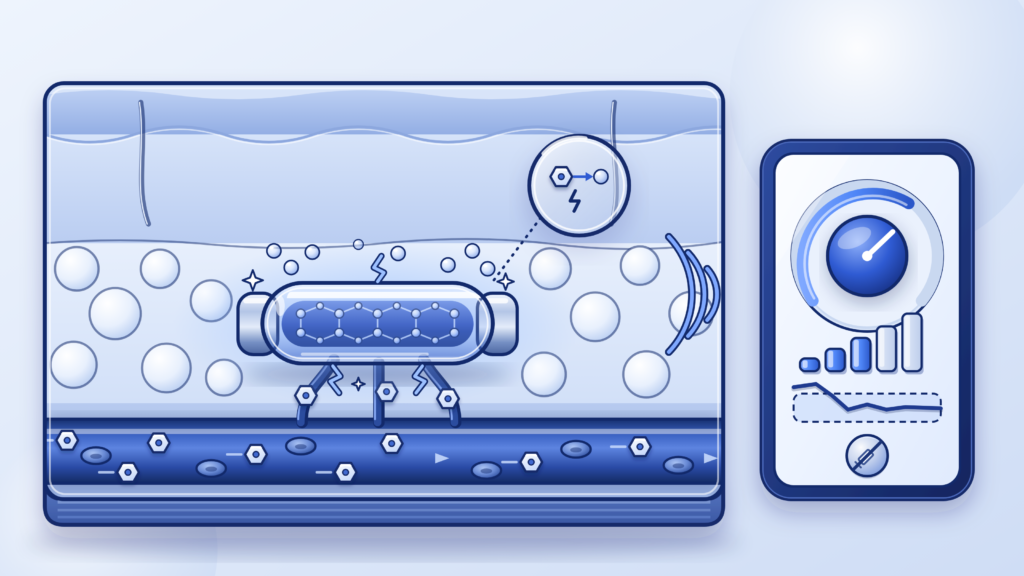
Type 2 diabetes is on the rise around the world. Unlike type 1 diabetes, it often stems from obesity, inactivity, and taking in more energy than the body needs over many years. Insulin injections can bring blood sugar down, but they do nothing about the body’s long-term energy surplus. Researchers at ETH Zurich have now developed an implantable system that relies on an electrically powered catalyst to reduce blood glucose.
The research team has spent years exploring systems that regulate blood sugar. Their earlier designs were built on custom genetic networks, but because those systems depend on biological parts, they face extra hurdles with immune tolerance, stability, manufacturing, and regulatory approval. The new implant sidesteps these issues by using a catalyst made only from inorganic materials, with no cells, enzymes, or other biological components. Under an electron microscope, the catalyst appears as spherical structures made of tiny gold platelets coated with platinum particles.
The catalyst turns excess glucose in the blood into gluconate, so some of that glucose is never metabolized and stored in tissue. This also helps curb the buildup of body fat, and the gluconate leaves the body in urine. The implant includes an electronic control unit inside a 3D-printed casing and receives power wirelessly at a frequency reserved internationally for industrial, scientific, and medical uses.
The system works as a closed loop. A standard glucose sensor of the kind many people with diabetes already wear on the upper arm keeps continuous track of glucose levels in the tissue. When blood sugar climbs too high after a meal, the sensor sends a Bluetooth signal to a smartphone or smartwatch, which then switches on the catalyst to convert the glucose using electrical energy.
In the lab, the team showed that the catalyst could convert glucose in a five-liter reservoir of nutrient solution, which is about the volume of blood in the human body. In tests on diabetic mice, the animals’ blood sugar was precisely regulated, the mice lost weight, the implant was well tolerated, and it worked reliably for six weeks. The system runs at a very low voltage, and the researchers found no sign of tissue damage from electrical or thermal effects. The device has not yet been tested in humans.
Looking ahead, the research team views the approach as a fundamental shift away from conventional drugs and toward scalable, electronically controlled treatments that can connect to digital environments such as the Internet of Things.
Article from ETH Zurich: Tackling diabetes with an electronic implant: how a tiny catalyst lowers blood sugar
Abstract in Science: Wireless electrocatalytic closed-loop system for drug-free management of diabesity
