
Removing a bandage is a minor sting for most people, but for newborns, older adults, and critically ill patients, repeatedly attaching and peeling off medical adhesives can irritate the skin, damage its outer layer, and even strip it away. Researchers at Pohang University of Science and Technology (POSTECH) in South Korea, working with Texas Tech University and in collaboration with Northwestern University, have developed a medical adhesive patch that holds firmly during use and comes off with far less force when it is time for removal.
Skin-mounted monitoring devices, such as sensors that track heart activity, breathing, and movement, need to stay firmly in place to collect reliable signals. For this reason, conventional medical adhesives are designed mainly to stick as strongly as possible. The trouble comes at removal. Strong adhesion produces large peeling forces and concentrated stress on the skin surface, which can lead to medical adhesive-related skin injury, especially in patients whose skin is fragile or repeatedly covered by adhesives.
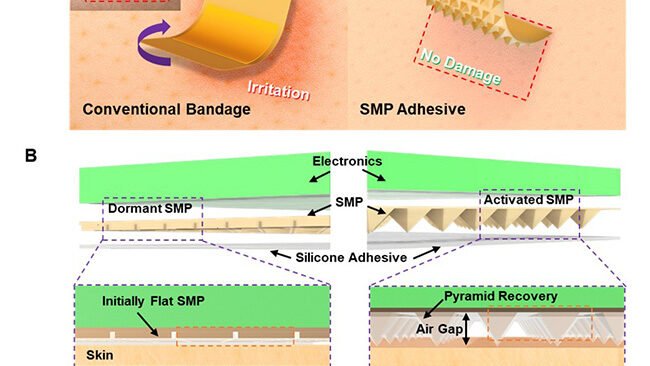
Rather than simply changing the adhesive material, the research team focused on controlling the mechanical forces where the skin and device meet. To do this, they turned to a shape memory polymer, a material that returns to a programmed shape when exposed to a specific temperature. The surface of the patch carries an array of tiny pyramid-shaped structures. In the patch’s dormant state, these pyramids are flattened, giving the adhesive broad contact with the skin for stable attachment. When the patch is mildly heated above its glass transition temperature, the pyramids recover their original shape. This reduces the area actually touching the skin and opens small gaps at the interface, so the patch releases with much lower force.
In experiments, heat activation cut adhesion energy by up to about 99 percent, while the adhesive still held steadily during use. The team used three-dimensional digital image correlation to visualize how tissue beneath the skin surface deformed during removal. Compared with the dormant state, the activated adhesive markedly lowered peel force and suppressed this deformation in both a skin model and human skin.
To help the patch fit curved areas such as joints, the researchers added a kirigami-inspired structure to the adhesive. This design improved how well the patch conformed to curved body regions and allowed moisture to pass through the adhesive layer more easily. The team also integrated the adhesive with wireless mechano-acoustic sensing devices, showing stable biosignal recording during normal wear and controlled removal after heating.
Looking ahead, the researchers see particular value for the patch in settings where sensors must be attached and removed repeatedly, including neonatal intensive care units, geriatric wards, and long-term patient monitoring. By easing the mechanical strain of removal, it could lower the risk of skin irritation and injury while keeping device performance reliable. The team also suggests that the ability to switch adhesion on demand could be extended to a broader class of technologies that require actively controlled adhesion.
Article from POSTECH: A Smart Adhesive Patch That Sticks Securely and Releases Gently Without Damaging Skin
Abstract in Nature Communications: Shape memory polymer adhesives for on-demand, low-force detachment in skin-interfaced devices
