
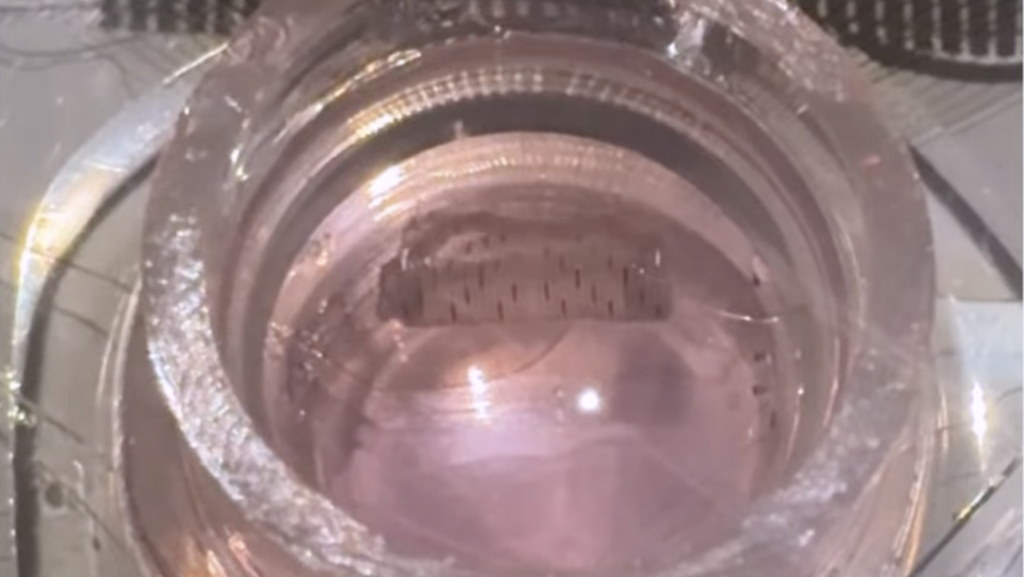
Wearable and implantable medical devices depend on batteries that are bulky, rigid, and eventually run out of charge, forcing replacements that can require surgery and limit device longevity. Researchers at the University of Massachusetts Amherst developed an ultrathin, flexible biohybrid mesh that integrates electronics directly with human cells, enabling a continuous and reliable electrical supply drawn from the body itself. The tech addresses one of the most difficult challenges in implantable and wearable electronics: eliminating the battery entirely.
The research team designed the mesh to mimic how the human body distributes energy. Instead of depending on a centralized power source, the mesh harvests energy from the natural electrical and mechanical activity of human cells. Every cell produces small amounts of power through electrical signaling or mechanical motion. The mesh captures this distributed energy using thin ribbons of a piezoelectric material that converts mechanical movement into electrical output. According to the researchers, the resulting power density is roughly ten times higher than what centralized harvesting systems typically achieve, providing a stable supply suitable for long‑term operation.
The mesh is ultrathin, flexible, and capable of conforming to living tissue. It moves with the body and maintains close contact with cells, allowing it to function like a biological component rather than a rigid implant. The researchers emphasized that this approach represents a shift in how medical devices can be powered, moving away from battery‑based architectures toward systems that operate continuously using the body’s own energy.
This work builds on earlier advances from the same research group, including meshes that grow with and monitor heart tissue, artificial neurons that communicate directly with living cells, and devices that harvest clean energy from thin air. The biohybrid mesh extends these concepts by showing that electronics can be powered indefinitely by the body without external charging or replacement.
The researchers noted that this technology could support a wide range of medical devices, including pacemakers, cochlear implants, deep brain stimulators, and wearable health monitors. By removing the battery, devices could become smaller, more flexible, and longer‑lasting, reducing surgical burden and improving patient comfort. They view the biohybrid mesh as a step toward electronics that integrate naturally with human biology and operate continuously using energy produced by the body.
Here’s a short video of the mesh:
Article from UMass Amherst: The Body Electric: UMass Amherst Researchers Integrate Electronics With Human Cells
Abstract in Science Advances: A biohybrid mesh harvester for distributed energy harvesting in living tissues
