
Astronauts have long faced a major challenge when dealing with injuries or illness in orbit because ultrasound has been the only practical imaging tool available. Ultrasound can be helpful, but it requires extensive training and depends on a sound‑transmitting medium, which is difficult to manage in a constantly moving spacecraft. For decades, experts believed that obtaining diagnostic‑quality X‑rays in space was impossible. A recent commercial spaceflight has now overturned that assumption by capturing the first diagnostic X‑rays during an orbital mission, marking a major step forward for astronaut health.
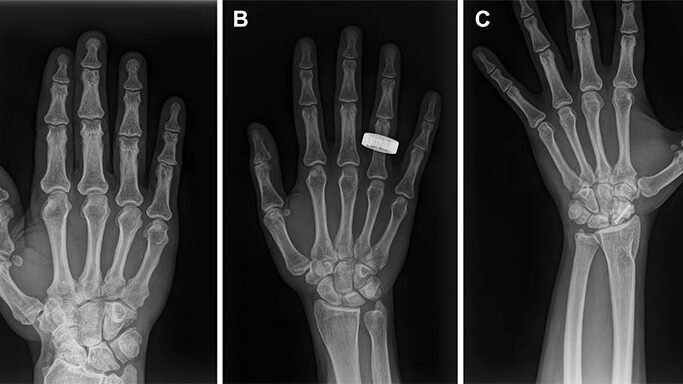
The breakthrough happened aboard SpaceX’s Fram2 mission, a 3.5‑day polar orbital flight. The crew carried a small, portable X‑ray machine that was light enough and stable enough to operate in microgravity. With only minimal medical training, the astronauts successfully took X‑ray images of the hand, chest and other body regions while in orbit. These scans were comparable to preflight and postflight images taken using the same protocol, showing that diagnostic imaging is possible even when everything inside the spacecraft is in motion.
Portable X‑ray systems have become smaller and more reliable in recent years, and they are already used in places far from traditional medical facilities, such as sporting events and low‑resource environments. Their compact size and wireless operation made them strong candidates for spaceflight. Before attempting orbital imaging, the research team tested the technology during a parabolic flight in 2022, where crew members obtained a digital hand X‑ray in simulated microgravity. That success encouraged the team to try full in‑orbit imaging.
The ability to take X‑rays in space has implications far beyond diagnosing injuries. Astronauts could use X‑rays to check for fractures, monitor lung conditions, or evaluate joint problems during long missions. The technology could also help inspect mission‑critical equipment such as spacesuit gloves, tools or electronics for hidden damage. As human spaceflight expands to longer journeys and more distant destinations, having more than one imaging method becomes increasingly important for keeping crews safe.
Researchers emphasize that this achievement represents the beginning of a new era in aerospace medicine. With portable radiography now proven feasible in orbit, future missions may carry more advanced imaging tools, giving astronauts better ways to monitor their health far from Earth.
Press Release from RSNA: First Diagnostic X-Rays in Space Mark New Era for Astronaut Health
Abstract in Radiology: SpaceXray: Feasibility and Diagnostic Capabilities of On-Orbit Medical Radiography
