
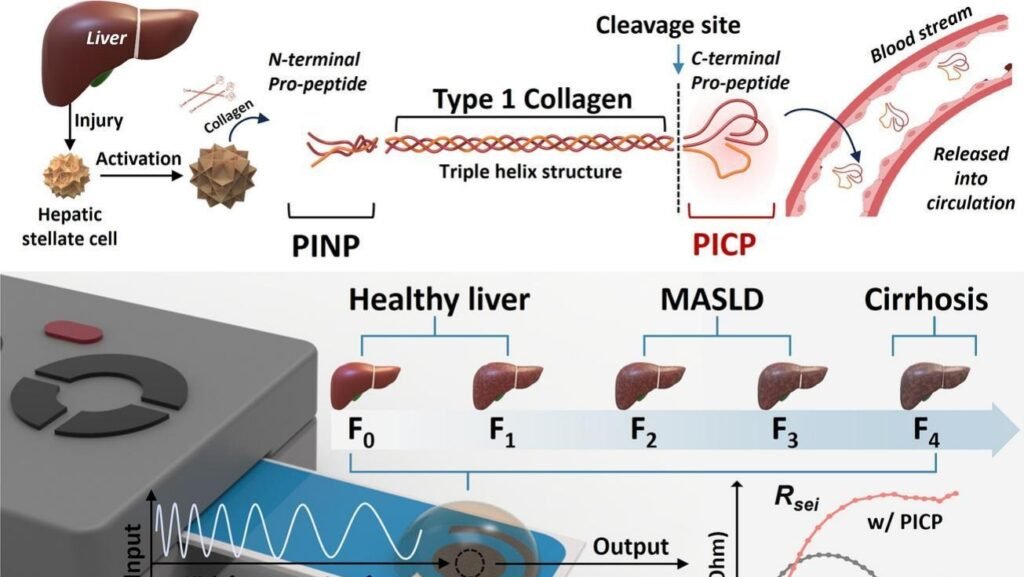
Liver fibrosis is a silent condition in which the liver gradually hardens like a callus, often without obvious symptoms until serious damage has already occurred. Today, doctors usually rely on liver biopsies or expensive imaging tests to detect fibrosis, procedures that can be painful, risky and difficult to repeat frequently. A research team at Sungkyunkwan University in Korea, has developed an ultrasensitive electrochemical biosensor that can detect early-stage liver fibrosis using only a small amount of blood. Their goal is to make it possible to identify liver problems early without the need for tissue biopsy.
The team focused on a protein called procollagen type I C-terminal peptide, or PICP, which is released into the bloodstream as the liver hardens and scar tissue builds up. Because PICP is closely linked to collagen formation in the liver, its concentration serves as a biomarker for how actively fibrosis is progressing. Detecting such a small signal in blood is challenging, so the researchers designed a diagnostic platform called FIB-EIS that uses a carbon electrode coated with gold nanoparticles. Antibodies that specifically bind to PICP are attached to the electrode surface. When PICP in the blood sample binds to these antibodies, it changes the electrical properties, or impedance, of the sensor surface in a way that can be precisely measured.
This physics-informed interfacial impedance sensing approach allows the biosensor to read the target protein directly through electrical signals, without special staining or complex processing. To prevent other blood proteins from interfering with the measurement, the team applied a blocking technique that keeps unwanted substances from sticking to the sensor. As a result, the device achieved very high sensitivity, detecting PICP at concentrations as low as 0.81 picograms per milliliter. In tests using blood samples from real patients, the platform was able to distinguish healthy individuals from those with liver fibrosis and to track different stages of disease.
The researchers emphasize that this technology opens a path to diagnosing liver abnormalities through blood analysis alone, reducing the need for invasive biopsies and making repeated monitoring more practical. Because the method is relatively simple and relies on electrical readout, it could eventually be adapted into a portable diagnostic device similar to a smartphone-based system. Early detection of liver fibrosis is important because lifestyle changes or medication can often slow or reverse the condition if it is caught in time. The team’s ultrasensitive biosensor offers a promising tool for precision detection in metabolic dysfunction-associated steatotic liver disease and could help bring earlier, more comfortable screening to a wider range of patients.
Article from Sungkyunkwan University: Development of the Ultrasensitive Biosensor for Detecting Early-Stage Liver Fibrosis Without Tissue Biopsy
Abstract in Chemical Engineering Journal: Precision detection of early-stage liver fibrosis in MASLD via physics-informed interfacial impedance sensing of procollagen type I C-terminal peptide
