
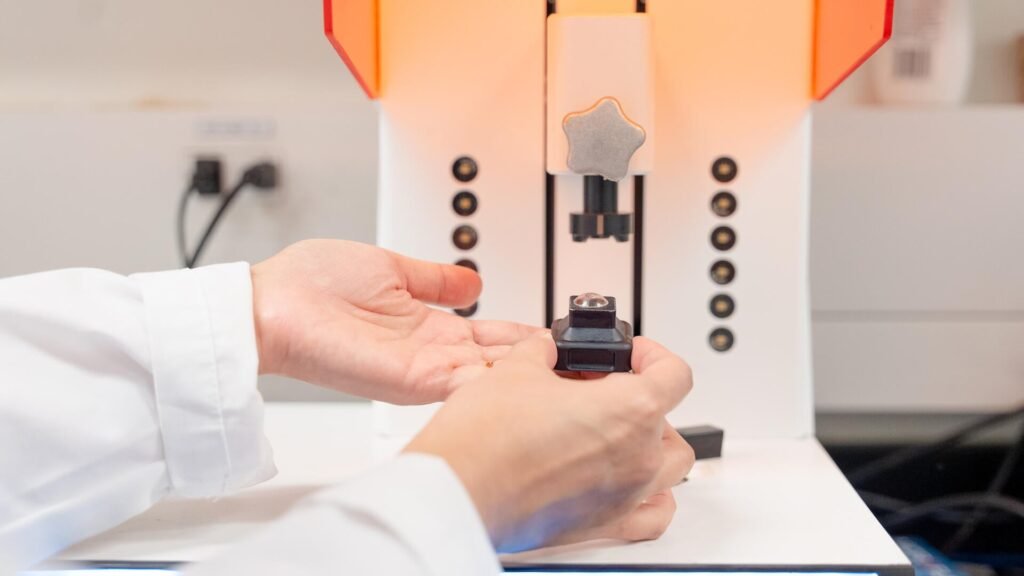
Finding the right contact lenses can be a slow and frustrating process for people whose eyes do not match standard lens shapes. Many patients with irregular corneas need rigid lenses that must be fitted over several appointments, and even then the results are not always comfortable. Researchers at the University of Waterloo have developed a new 3D‑printing platform that could make this process much easier by creating personalized contact lenses in about twenty minutes. Their work shows how custom lenses could be designed, printed and dispensed during a single visit to the optometrist.
The team’s approach combines custom lens‑design software, advanced manufacturing techniques and a newly developed silicone material. Silicone is widely used in contact lenses because it is safe, breathable and comfortable, but traditional silicone formulations do not work well with 3D printing. To solve this problem, the researchers created a hydrophilic silicone specifically for additive manufacturing. This material keeps the oxygen permeability and clarity needed for contact lenses while allowing the lens to be printed layer by layer.
The software designs each lens with an inner surface that matches the patient’s cornea and an outer surface that provides the needed vision correction. This level of customization helps ensure a precise fit, which is especially important for patients who cannot use standard soft lenses. The printed lenses are smooth and transparent, but because 3D printing can leave tiny stair‑step imperfections on curved surfaces, the team added an ultra‑thin, non‑contact coating process that smooths the lens without changing its customized shape. This coating improves comfort and optical quality, making the lenses comparable to commercial products.
The researchers emphasize that their platform could shorten the entire fitting process from weeks or months to a single appointment. Instead of trying multiple diagnostic lenses, patients could receive a lens designed exactly for their eye shape while still benefiting from the clarity and durability expected of rigid lenses. The technology also opens the door to future innovations in personalized vision care, where lenses can be tailored not only for shape but potentially for specialized optical functions.
Article from the University of Waterloo: 3D-printed contact lenses for your eyes only in just 20 minutes
Abstract in Materials & Design Patient-specific hard contact lenses fabricated by vat photopolymerization printing and non-contact fluidization coating
