
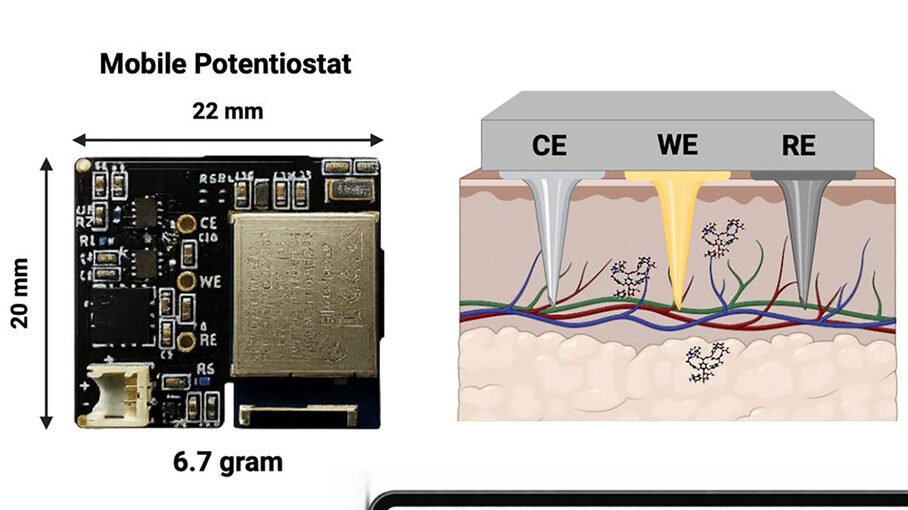
Many medicines require careful dosing, yet doctors often rely on occasional blood tests that provide only brief snapshots of drug levels. This approach can make it difficult to understand how a medicine moves through the body over time. Researchers at King Abdullah University of Science and Technology in Saudi Arabia have developed a lightweight wearable patch that could change this by measuring drug concentrations beneath the skin continuously and sending the information to a smartphone. Their work suggests that future wearable devices may help track therapies inside the body just as easily as they track heart rate or sleep.
The patch uses an array of tiny microneedles that reach the interstitial fluid just under the skin. This fluid contains chemical information similar to what is found in blood, allowing the patch to monitor drug levels without traditional blood draws. The microneedles are paired with miniaturized electronics and Bluetooth communication, creating a small, flexible system that weighs only 6.7 grams. Once placed on the skin, the patch continuously measures drug concentrations and displays the data on a smartphone, giving users and clinicians a clearer picture of how a medicine behaves throughout the day.
To demonstrate the technology, the researchers tested the patch with vancomycin, an antibiotic used to treat serious infections. Vancomycin must stay within a narrow concentration range to remain safe and effective, which makes it an ideal example of a drug that benefits from close monitoring. In laboratory and preclinical studies, the patch successfully tracked changing vancomycin levels over several hours, showing that continuous monitoring is possible with a wearable device rather than repeated blood tests.
The team explains that wearable devices have already transformed how people monitor physical activity, sleep and heart rate. Their goal is to extend this convenience to medication monitoring, giving patients and clinicians real‑time insight into how treatments are working. They note that the technology is still in its early stages but represents a new direction for personalized medicine. Instead of relying on occasional measurements, future wearables could help ensure that medicines stay within the right range, improve dosing decisions and reduce the need for frequent lab visits.
