
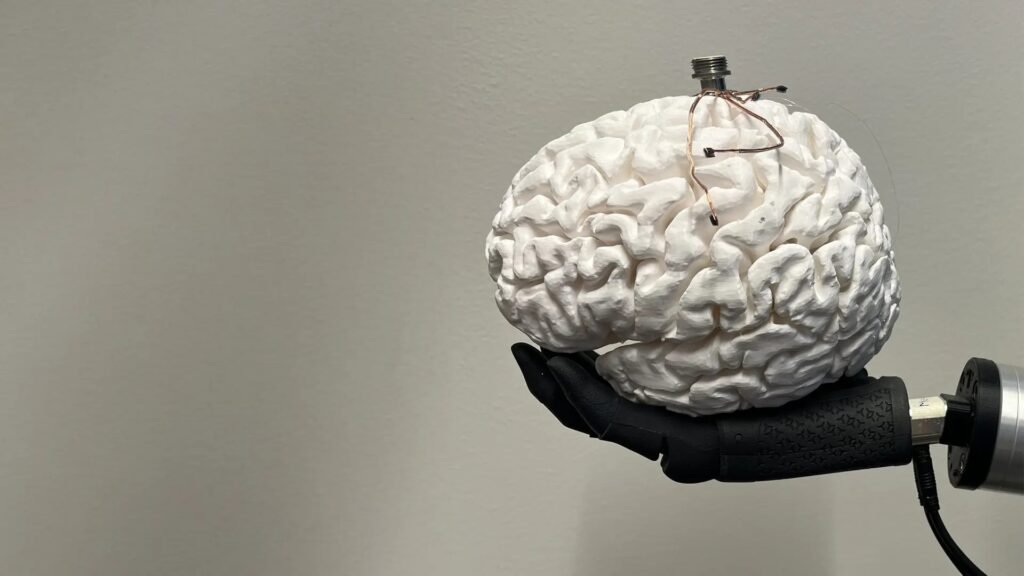
Patients with severe sight loss or loss of motor function often have few treatment options because damaged neural pathways cannot be repaired easily, leaving them without reliable ways to regain vision or tactile sensation. Researchers now report that two major branches of brain‑computer interface technology, long developed separately for artificial vision and artificial touch, are built on nearly identical principles. This finding suggests that a single technological framework could support restoration of multiple senses, potentially accelerating progress for patients with otherwise untreatable conditions.
The review, led by Chalmers University of Technology in Sweden, examines visual cortical prostheses and somatosensory cortical prostheses side by side. Both rely on microelectrodes implanted directly into the brain to bypass damaged pathways and stimulate specific cortical regions. In artificial vision, the electrodes interface with the visual cortex to generate percepts based on external input such as a camera. In artificial touch, the electrodes stimulate somatosensory regions to recreate tactile sensations for patients using prosthetic limbs. Although these technologies emerged independently over more than fifty years, they share the same underlying goal of converting complex external information into electrical signals that the brain can interpret.
Valle notes that researchers in the two fields have historically worked in isolation, attending different conferences and treating different patient groups. Yet natural vision and touch rely on similar neural and computational processes, and both artificial systems mimic these processes by delivering patterned electrical stimulation. The review highlights how each field has addressed challenges such as electrode design, cortical mapping, and the creation of meaningful artificial sensations. It also compares clinical trial results and identifies technical barriers that remain, including improving perceptual resolution and ensuring long term stability of implanted devices.
The inspiration for merging the two fields came from work on restoring more complex tactile sensations, such as edges or motion. Valle observed that artificial vision researchers were pursuing similar goals as they attempted to create richer visual experiences. This convergence reflects the rapid development of brain interfacing technology, which has brought the two areas to a point where shared strategies could accelerate progress for both.
The authors argue that collaboration between artificial vision and artificial touch researchers could lead to unified systems capable of restoring multiple senses. Valle envisions a future in which hospitals have dedicated departments for sense restoration, offering patients access to technologies that can help them regain sight, tactile feedback, or motor control through a common platform. The review positions this integration as a step toward making advanced neural prostheses more accessible and more effective for diverse patient populations.
Article from Chalmers University of Technology: Restoring lost senses: one technology for both artificial vision and touch
Abstract in Nature Reviews Bioengineering: Restoring vision and touch with cortical microstimulation

How could recognizing the shared principles behind artificial vision and artificial touch brain-computer interfaces accelerate the development of technologies that restore multiple human senses?