
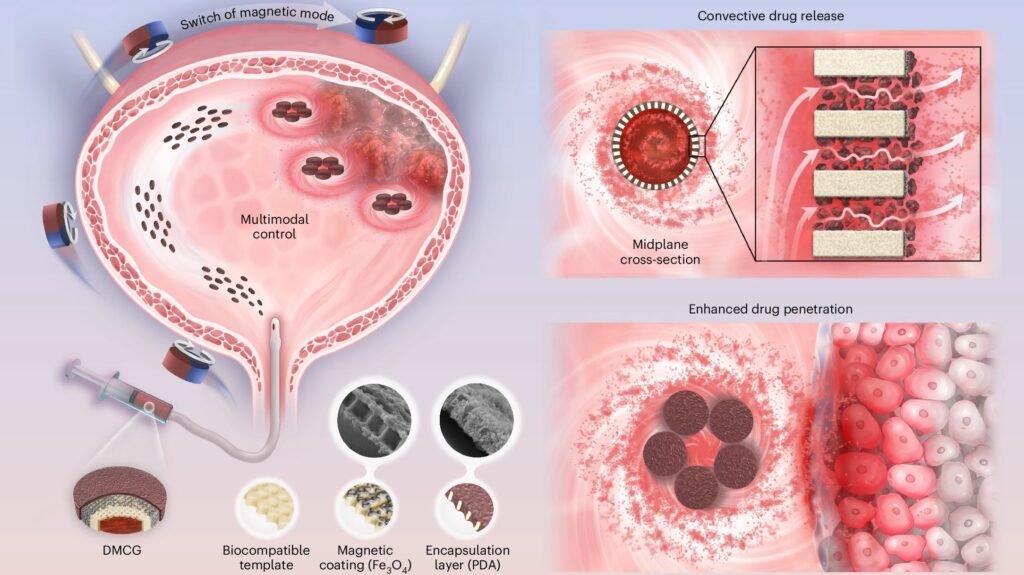
Bladder cancer treatment often falls short because chemotherapy drugs struggle to penetrate deeply into tumor tissue, limiting their effectiveness and requiring longer exposure times or higher doses. Researchers at the University of Edinburgh and Xiamen University have developed algae based microbots that aim to overcome this challenge by transporting chemotherapy drugs directly into tumors with far greater precision. The approach uses natural microalgae engineered into magnetic biohybrid robots that can be guided through the bladder using externally controlled magnetic fields. Their ability to move collectively and navigate tight spaces allows them to deliver drugs more efficiently than conventional instillation methods.
The microbots are created from single celled algae that are biocompatible and biodegradable, making them suitable for use inside the body. Their nanoporous structure allows them to securely hold chemotherapy drugs such as doxorubicin and release them in a controlled manner. Because algae are abundant and inexpensive, the system is designed to be scalable and cost effective. Once loaded with the drug, the microbots can be directed toward tumors using programmed magnetic fields, enabling targeted delivery that minimizes exposure to healthy tissue.
Real time ultrasound imaging allows researchers to track and control the microbots as they move through the bladder. By adjusting the magnetic fields, the team can switch the microbots between transport and release modes, causing them to roll or rotate as needed to deliver the drug. The coordinated movement of the swarm has been compared to schools of fish or flocks of birds navigating through narrow environments. This level of control enables the microbots to reach deeper layers of tumor tissue that are typically difficult for drugs to access.
In mouse studies, the microbots increased drug penetration by more than ten times compared with standard treatment. After one week of therapy, tumor burden was reduced to less than three percent of that seen in mice receiving conventional drug instillation. The treatment could be completed in about thirty minutes, significantly shorter than the prolonged exposure times often required in current clinical practice. Researchers note that the improved efficiency may support less invasive strategies for bladder cancer care, although additional studies will be needed before clinical translation.
The work highlights how biohybrid microrobotics can address biological barriers that limit the effectiveness of local chemotherapy. By combining natural materials with magnetic control and real time imaging, the technology offers a way to deliver drugs exactly where they are needed while reducing side effects.
Article from the University of Edinburgh: Algae microbots take aim at bladder cancer
Abstract in Nature Nanotechnology: Machine-intelligent multimodal algebot for intracavitary chemotherapy
