
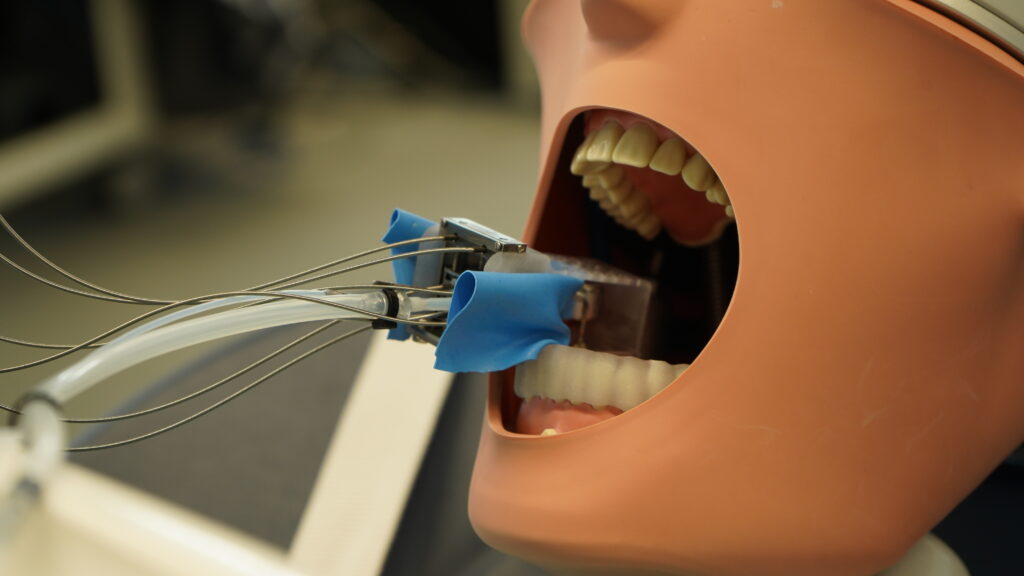
Dental crown procedures often require multiple appointments because preparing a damaged tooth, taking impressions, and fitting a temporary crown must be completed before the permanent crown can be placed. Researchers at the University of Basel have developed a miniature robot designed to simplify this process by preparing teeth automatically according to a digital plan. The prototype, known as the Miniature Intraoral Robot, or MIR, is intended to reduce the number of visits needed for crown treatment by performing precise tooth preparation after a single scan.
The robot measures only 43 by 26 by 28 millimeters, making it small enough to fit comfortably inside an open mouth. Its motors and control components are located outside the mouth and connected to the robot through flexible shafts, cables, and tubes. The research team describes the device as compact and suitable for intraoral use. After a dentist scans the patient’s tooth, the digital model can be used both to design the crown and to generate a custom fitted dental splint that anchors the robot in place. Because the splint moves with the patient, the robot maintains its position even if the patient shifts during treatment.
MIR prepares the tooth in two stages. First, a wide drill reduces the surface from above, removing the necessary material. Then a longer, thinner drill shapes the sides of the tooth. Tests on synthetic resin models and ceramic materials with enamel like hardness showed that the robot can achieve high precision even without integrated sensors. The positional error measured less than 0.2 millimeters, a level of accuracy the researchers expect to improve once sensors are added. The team also measured drilling forces, which remained below five newtons, comparable to the weight of a half liter bottle of water. Noise levels are being evaluated to determine how the system might perform in a clinical environment.
Future development will focus on integrating sensors and a camera so the robot can monitor its position and track treatment progress. The researchers aim to achieve this without increasing the robot’s size. They note that sensor data would allow the robot to resume work accurately even after a power interruption. The project is part of an Innosuisse funded collaboration involving the University of Zurich, Camlog Biotechnologies in Basel, and the University of Bern. By combining engineering expertise with clinical input, the team hopes to create a tool that can make crown preparation faster, more consistent, and less dependent on multiple appointments.
Article from the University of Basel: A mini robot to simplify dental treatment
Abstract in IEEE Transactions on Medical Robotics and Bionics: Miniature Intraoral Robot (MIR) for Minimally Invasive Tooth Preparation
