
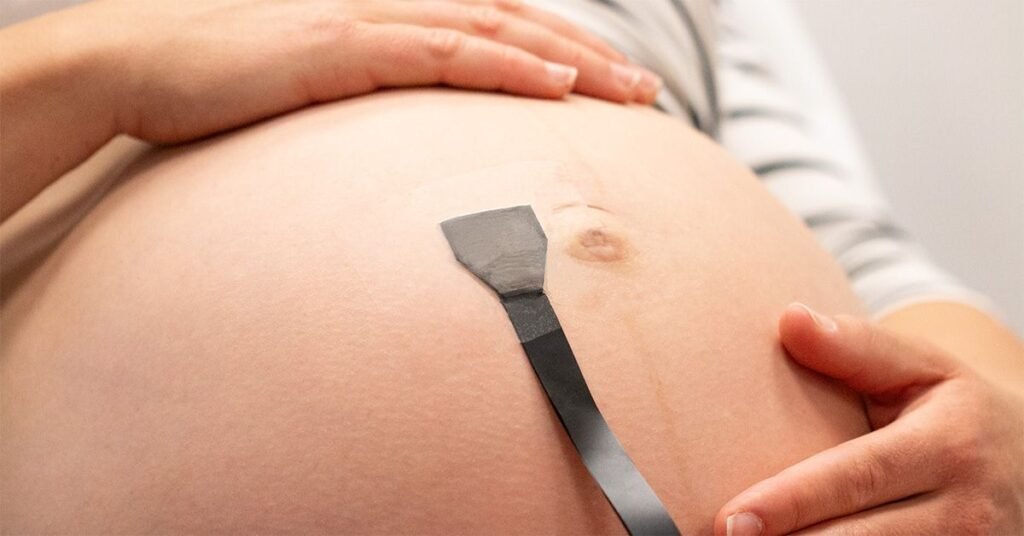
Many complications in high risk pregnancies go undetected because standard ultrasound exams provide only brief snapshots of fetal health rather than continuous information. Researchers at the University of California, San Diego have developed a soft, wearable ultrasound patch that aims to close this gap by offering long duration, real time monitoring of the fetus and umbilical cord. The patch adheres to the abdomen and maintains stable imaging even as the fetus moves, which has been one of the most difficult challenges in extending ultrasound beyond short clinical sessions.
The device is built from a flexible array of ultrasound transducers embedded in a thin, skin conforming material. Once placed on the abdomen, it can capture hours of imaging data without requiring a trained sonographer to hold or adjust a probe. The research team designed autonomous tracking algorithms that can identify the umbilical cord and follow it as it shifts position. This allows the system to record changes in blood flow that would normally be missed between routine prenatal visits. The patch can also visualize fetal anatomy and motion, giving clinicians a more complete picture of fetal well being over time.
During early clinical testing, the patch revealed prolonged abnormal blood flow patterns in one participant. The clinical team determined that the fetus was in distress and recommended an early Cesarean delivery. The researchers reported that the newborn recovered well, and they believe the continuous monitoring provided by the patch played a critical role in identifying the problem before it became life threatening. This case illustrates the potential of the technology to detect complications such as fetal growth restriction or preeclampsia earlier than current tools allow.
The team notes that the patch could be especially valuable in settings where access to trained ultrasound technicians is limited. Because the device operates autonomously and does not require specialized handling, it could expand access to advanced prenatal monitoring in low resource environments. The work appears in Nature Biotechnology and represents a step toward autonomous, long term fetal monitoring that could improve outcomes for mothers and babies.
Article from UCSD: Wearable Ultrasound Patch Could Improve Care for High-Risk Pregnancies
Abstract in Nature Biotechnology: Fetal monitoring for high-risk pregnancies using a wearable ultrasound patch
