
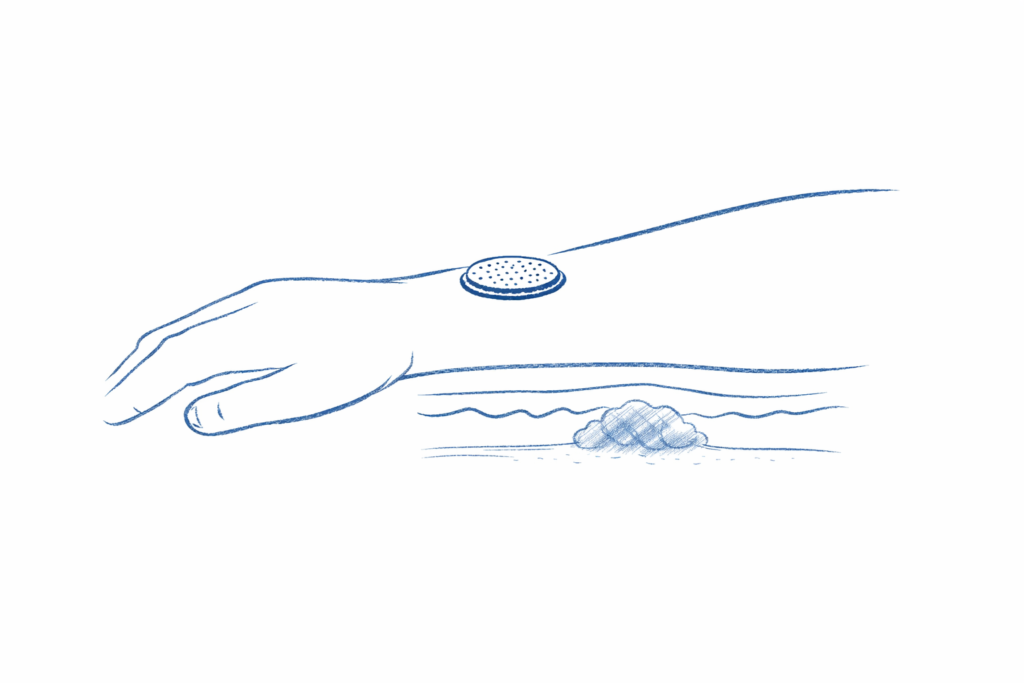
Skin cancer often develops invisibly beneath the surface long before visible lesions appear, making early detection difficult. Researchers at the University of Montreal have created a temporary “intelligent tattoo” that can identify micro‑melanomas before they become visible. The system, called “SMEAR‑ULM” , measures subtle temperature changes on the skin to reveal early metabolic activity linked to cancer.
The tattoo uses a patch of painless microneedles that deposit specialized nanoparticles just beneath the skin. These particles act as sensors, detecting minute thermal variations caused by abnormal cellular metabolism. The patch communicates these signals through an ultrafast imaging system. The technology was validated in preclinical studies on mice whose genetic profiles mimic human melanoma, showing that it can detect tumors too small for clinical inspection.
Current diagnostic methods rely on visual examination and biopsy, which can be invasive and sometimes unnecessary. By contrast, this tattoo offers a minimally invasive, real‑time assessment of suspicious areas. It could reduce unnecessary biopsies, improve diagnostic accuracy, and enable earlier intervention. The researchers emphasize that melanoma incidence continues to rise in Canada, and tools that identify disease before visible symptoms appear are critical to improving survival rates.
The system also redefines how temperature is used in cancer detection. Tumors generate more heat due to their metabolic activity, but traditional thermography lacks precision. SMEAR‑ULM converts these faint signals into measurable data, turning heat into a reliable biomarker. The team, including professors Fiorenzo Vetrone, Davide Brambilla, and Sylvain Meloche, plans to refine the technology for human trials and explore its integration with wearable health monitoring systems.
This innovation represents a new frontier in dermatological diagnostics, combining nanotechnology, biophotonics, and intelligent sensing to make invisible cancers detectable before they emerge.
Article from the University of Montreal: An “intelligent tattoo” to detect skin cancer before it appears
Abstract in Nature Sensors: Single-shot microneedle-encoded upconversion lifetime mapping for real-time in vivo thermo-dermoscopy
