
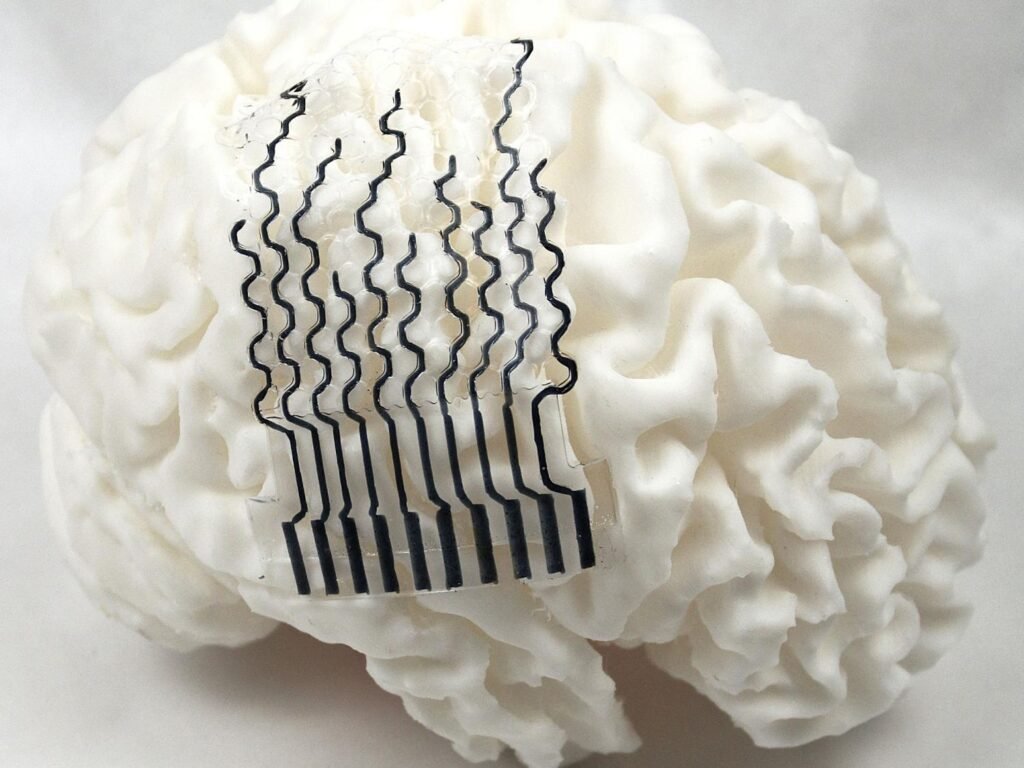
Understanding how the brain responds to injury or disease is one of the biggest challenges in neuroscience, yet most tools for monitoring neural activity are rigid, invasive, or poorly matched to the soft, curved surface of the brain. These limitations make it difficult to capture accurate signals and nearly impossible to tailor sensors to the needs of individual patients. Researchers at Pennsylvania State University have developed a new approach that addresses this problem by using 3D printing to create soft, flexible brain sensors that conform to the brain’s surface and can be customized for each person.
The team focused on a class of devices known as electrocorticography sensors, which sit directly on the brain to record electrical activity. Traditional versions are manufactured in fixed shapes and sizes, which limits their ability to fit the unique anatomy of each patient. The Penn State researchers used a specialized 3D printing technique to fabricate sensors made from soft, stretchable materials that match the mechanical properties of brain tissue. This allows the sensors to bend and flex without damaging the tissue or losing signal quality.
A key advantage of the printing process is the ability to rapidly produce sensors with different geometries. The team demonstrated that they could print arrays with customized layouts, electrode densities, and shapes that follow the contours of individual brains. This capability opens the door to personalized neural monitoring, where clinicians could design sensors that target specific regions affected by epilepsy, traumatic brain injury, or neurodegenerative disease.
The researchers also showed that the printed sensors maintain strong electrical performance. They tested the devices on curved surfaces and observed stable signal recording even when the sensors were stretched or deformed. This resilience is important because the brain moves slightly with each heartbeat and breath. A sensor that can move with the tissue without losing contact is more likely to capture accurate, long term data.
The team envisions several future applications. Personalized sensors could help surgeons map brain activity more precisely during operations. They could also support long term monitoring for patients with chronic neurological conditions, providing clearer insight into how disease progresses or how treatments are working. Because the printing process is relatively fast and inexpensive, it could make advanced neural interfaces more accessible.
The researchers plan to continue refining the materials and printing methods to improve durability and biocompatibility. Their work suggests that 3D printed, patient specific brain sensors may become an important tool for personalized neuroscience, offering a safer and more adaptable way to monitor the brain in real time.
Article from Penn State: 3D-printed brain sensors may unlock personalized neural monitoring
Abstract in Advanced Materials: 3D-Printable, Honeycomb-Inspired Tissue-Like Bioelectrodes for Patient-Specific Neural Interface
