
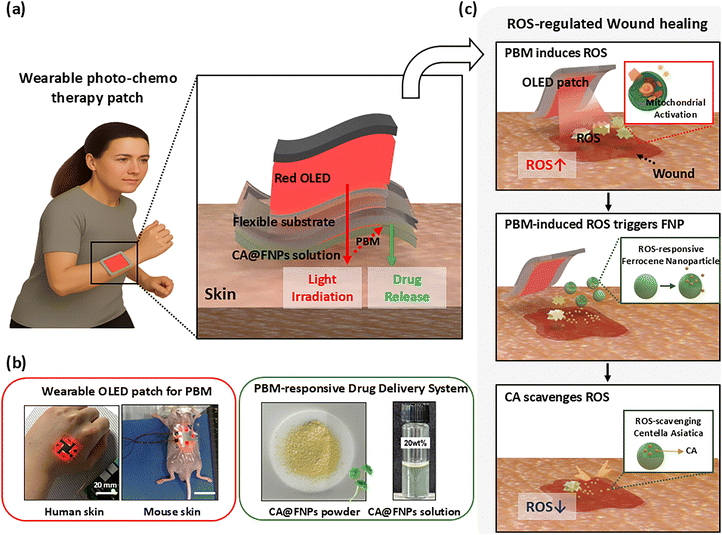
Treating skin wounds often relies on ointments or light therapy, but both approaches have a similar problem: it is hard to deliver the right dose over time. Too much ointment can cause side effects, and too much light can reduce the benefits of photobiomodulation, the technique that uses specific wavelengths of light to stimulate cell repair. A research team at the Korea Advanced Institute of Science and Technology (KAIST) has developed a smart wound patch that solves this dosing problem by combining an organic light emitting diode, or OLED, with a drug delivery system that responds automatically to the body’s chemistry.
The core idea is that light controls the medicine. The flexible OLED patch emits red light at a wavelength of about 630 nanometers, which promotes cell regeneration through photobiomodulation. At the same time, this light triggers the production of reactive oxygen species, or ROS, in the tissue. The researchers designed ROS responsive nanoparticles that release antioxidant drugs only when ROS levels rise. As a result, the same light that stimulates healing also acts as a switch that controls when and how much drug is released. The system keeps treatment within an effective range without constant human adjustment.
In animal studies, the combined light and drug therapy significantly accelerated wound closure compared with either treatment alone. The team reported roughly double the healing speed and better quality of repaired tissue, including stronger skin barrier function and more mature blood vessels. They also identified an optimal light dose range, showing that the patch can deliver a dose dependent additive effect while avoiding the drop in benefit that occurs with excessive light exposure.
Because the OLED patch is thin, flexible, and able to conform closely to the skin, it can be worn comfortably over a wound. The researchers see this as a step toward intelligent wound care, where a single wearable device can sense aspects of the local environment and automatically adjust therapy in real time. By turning light into both a healing signal and a control mechanism for drug release, this technology points to a new class of smart dressings that could improve recovery, reduce side effects, and make advanced wound treatment more accessible outside specialized clinics.
Article from KAIST: Smart OLED Patch Uses Light to Automate Drug Delivery, Doubling Healing Speed
Abstract in Materials Horizons: A self-regulating wearable OLED patch for accelerated wound healing via photobiomodulation-triggered drug delivery
