
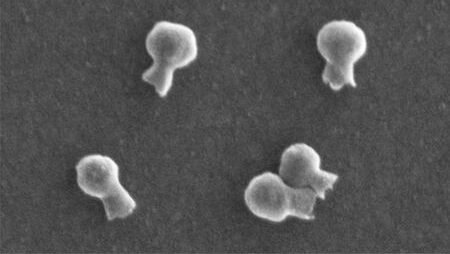
The brain has several layers of protection that keep out dangerous invaders, but one of them, the blood-brain barrier, also makes it very hard to treat brain diseases. This protective filter lines the brain’s blood vessels and is notoriously difficult to get through. Many medications are given by injection into a vein, but the barrier keeps most drugs from reaching the brain in large enough amounts. Researchers at the California Institute of Technology (Caltech) have developed a nanorobotic system called BrainBots that can help carry medication across the blood-brain barrier, delivering about five times more medication to the brain when activated by light than when not activated.
The research team built the BrainBots from established materials that are safe for the body and biodegradable. Shaped like tiny, lopsided balloons, each one has a chamber filled with ammonium bicarbonate, a fuel that produces gas. The chamber is sealed inside a shell with a heat-sensitive gate and attached to a drug payload. At about 250 nanometers across, the capsules are hundreds of times smaller than the width of a human hair. After they are injected into the bloodstream, near-infrared light is shined through the skull to activate the BrainBots near the barrier. The light creates localized heat that melts the gate and triggers gas production, propelling the BrainBots into contact with the cells lining the barrier. Specialized DNA molecules called aptamers on the BrainBots help them recognize and attach to these cells, which then take them up and transport them into the brain. Once inside, the BrainBots break down further to release their medication, and the entire structure eventually disintegrates.
The researchers tested the BrainBots in mice with glioblastoma, the most common type of brain cancer. The ability to move toward their target cells greatly improved delivery of the powerful chemotherapy drug doxorubicin to the brain. The treatment slowed tumor growth and extended survival without any detectable disruption of the blood-brain barrier, and it caused less toxicity throughout the body than giving the chemotherapy drug alone. Only a fraction of the BrainBots reached the brain. Those remaining elsewhere were expected to break down after being taken up by organs such as the liver and spleen, as is typical for most nanoparticle drug carriers.
The work builds on the research team’s earlier nanobots for targeted drug delivery, including a version that carried anti-tumor treatments to bladder tumors. Next, the researchers plan to optimize the near-infrared light delivery and study the long-term safety, stability, and breakdown of the nanorobots in the body before moving toward human studies. Although this study focused on cancer, the team notes that the technology is not limited to the brain and hopes it could also benefit neurological diseases such as Parkinson’s.
Article from Caltech: Tiny Robots Deliver Treatments to the Brain
Abstract in Science Robotics: Photothermally gated nanorobots for active blood-brain barrier transcytosis and brain delivery
