
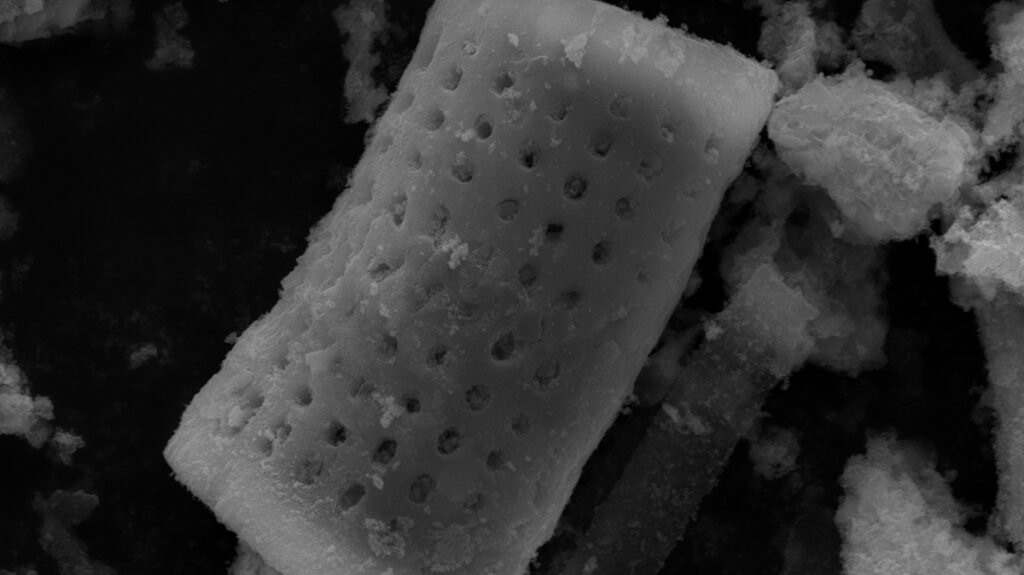
Cleaning wounds and surgical instruments is often difficult because bacteria and debris often cling to surfaces that are hard to reach with conventional methods. Researchers at the University of Illinois Urbana‑Champaign have developed a new approach that uses tiny microparticles to generate cavitation bubbles capable of dislodging contaminants more efficiently. Their work demonstrates how controlled bubble formation can improve both medical wound care and the cleaning of surgical tools.
The team designed microparticles that create cavitation when exposed to ultrasound. Cavitation occurs when small bubbles rapidly form and collapse, producing localized forces strong enough to lift debris from surfaces. In traditional cleaning systems, cavitation is generated by large ultrasound transducers, but the effect is often uneven and difficult to direct. By embedding cavitation‑producing microparticles directly into a cleaning solution, the researchers created a way to deliver bubble activity precisely where it is needed.
The microparticles contain a gas core surrounded by a shell. When ultrasound waves pass through the solution, the gas core expands and contracts, producing bubbles that collapse with enough force to remove contaminants. The researchers tested the system on wound models and found that the bubbles could lift debris from tissue surfaces without causing additional damage. They also demonstrated that the particles could clean surgical instruments more effectively than standard ultrasonic baths, which often struggle to reach crevices and textured surfaces.
The team emphasized that the microparticles do not rely on chemical disinfectants. Instead, they use mechanical action to remove debris, which may help reduce reliance on harsh cleaning agents. The researchers also noted that the particles can be tuned to produce different levels of cavitation by adjusting their size and shell properties. This flexibility allows the system to be adapted for delicate tissues or more robust materials.
Experiments showed that the microparticles produced consistent cavitation activity across a wide area, improving cleaning uniformity. The researchers observed that debris lifted from surfaces could be flushed away easily once dislodged. They also found that the particles remained stable during use, making them suitable for repeated cleaning cycles.
The team envisions applications in wound care, surgical instrument sterilization and other medical settings where debris removal is essential. By providing a more targeted and controllable way to generate cavitation, the microparticle system could help improve hygiene, reduce infection risk and support more effective cleaning protocols.
Here’s a brief timelapse showing the bubble-generating microparticles infiltrating a biofilm:
