
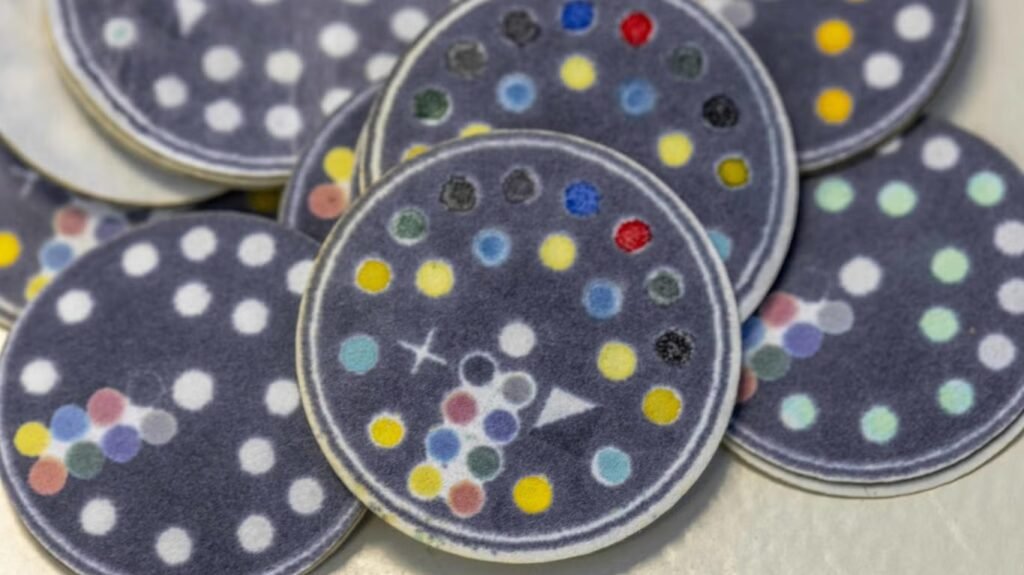
Monitoring premature infants is challenging because traditional sensors rely on wires, adhesives and repeated blood draws that can irritate fragile skin and cause stress during critical stages of development. Researchers from Tufts University and several universities in Germany have developed a featherlight silk‑based sticker that tracks four essential health signals without needles or electronic monitors. Their work shows how a simple color‑changing patch combined with an AI system can provide continuous, noninvasive monitoring inside neonatal incubators.
The patch is smaller than a coin and captures temperature, pH, sodium and glucose from the tiny amounts of interstitial fluid that naturally pass through a newborn’s developing skin. Each parameter is represented by a colorimetric dot that shifts color as the underlying chemistry changes. An AI system reads these color changes through any standard camera, even in the dim and humid environment of an incubator, and converts them into precise numerical values. This approach allows clinicians to track multiple variables at once, offering a more complete picture of an infant’s condition than single‑parameter measurements.
Researchers emphasize that the newborn is the most demanding patient because their skin is delicate and their physiology changes rapidly. The patch avoids wires, adhesives that tug on skin and repeated needle sticks. It listens passively to the body, providing information that often emerges between scheduled lab tests. The team notes that continuous monitoring can detect slow drifts toward problems that might otherwise go unnoticed until they become emergencies.
The sensor is built in thin layers. A silk fibroin base stabilizes biological molecules, including enzymes that typically require refrigeration, making the patch shelf‑stable and durable. A wax‑printed paper layer acts as a microfluidic system that draws in microscopic volumes of fluid. As the fluid reaches each sensing dot, the color shifts in response to biochemical changes. The design leverages the natural permeability of premature skin, turning a biological vulnerability into a diagnostic advantage.
The researchers developed a deep learning system to interpret the color changes accurately despite fluctuating lighting and movement. The algorithm translates the visual data into actionable numbers with high accuracy, enabling clinicians to detect issues such as hypoglycemia. The team envisions expanding the patch to measure additional parameters like oxygen saturation and carbon dioxide. They also anticipate clinical trials to validate the technology and compare its performance with standard blood assays.
Article from Tufts University: A Noninvasive Way to Monitor Babies’ Health
Abstract in ACS Sensors: Artificial Intelligence-Supported Colorimetric Multibiomarker Sensor to Enable Critical Neonatal Monitoring
