
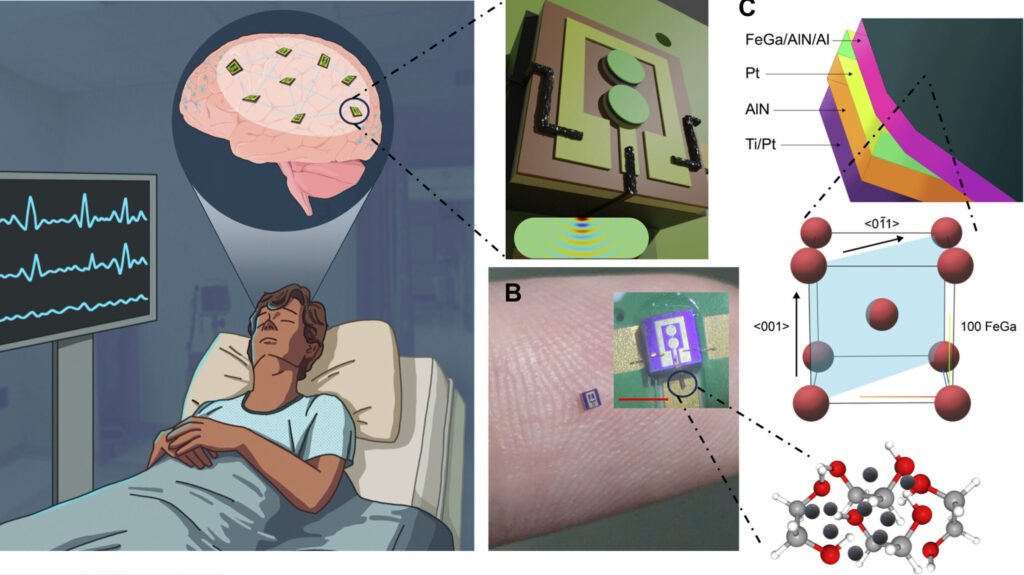
Implantable medical devices often struggle to balance size, heat generation and data capacity, making long‑term use uncomfortable and limiting their ability to diagnose or treat disease. Researchers led by the University of Glasgow have developed a new class of ultra‑small antennas, called µBots, that can wirelessly transmit rich streams of data through biological tissue while remaining cooler, smaller and more energy efficient than conventional radio‑frequency implants. Their work demonstrates how magnetoelectric antennas built on acoustically active substrates can support advanced sensing and neuromodulation applications inside the body.
The µBots combine acoustic and electromagnetic physics to create antennas that exploit unusual resonances within the substrate material. Instead of treating the wafer as an inert base, the team used its acoustic properties to generate overtones that enhance both power transfer and data transmission. This approach produced a device with a broad bandwidth of up to 22.6 GHz, enabling significantly higher data throughput than traditional RF antennas. To demonstrate this capability, the researchers wirelessly transmitted real‑time sonogram video and audio signals between two magnetoelectric antennas, a demanding test that exceeds the binary data streams typically used to benchmark implantable systems.
The prototypes were fabricated and tested in biological environments to evaluate safety and performance. Measurements taken in rat brain tissue, human cortical brain slices and controlled cell cultures showed that the µBots maintained reliable telemetry across all conditions. Their small size and low heat output make them promising candidates for chronic implantation, where comfort and tissue compatibility are essential. Neuroscientists collaborating on the project noted that the technology could allow researchers to map and modulate neural circuits with greater spatial precision while supporting long‑term electrophysiology and neuromodulation studies.
The team also addressed a common challenge in implantable communication systems: misalignment between internal and external antennas. By arranging nine µBots into a phased array, they matched the alignment performance of a single large RF antenna while maintaining a far smaller footprint suitable for confined spaces such as the brain. Cyclic stability tests confirmed that the antennas remained reliable after repeated loading with tissue, reinforcing their potential for real‑world use.
Researchers envision µBots enabling earlier diagnosis of neurodegenerative diseases, targeted drug delivery and advanced neuromodulation therapies for conditions such as epilepsy and Parkinson’s disease. Continued development will focus on further trials and eventual commercialization, with the goal of creating implantable platforms that provide continuous monitoring and treatment with minimal invasiveness.
Article from the University of Glasgow: Antenna breakthrough could unlock new generation of implantable devices
Abstract in Science Advances: Bio-integrated μBots with overtone ultrawideband magnetoelectric antennas for wireless telemetry
