
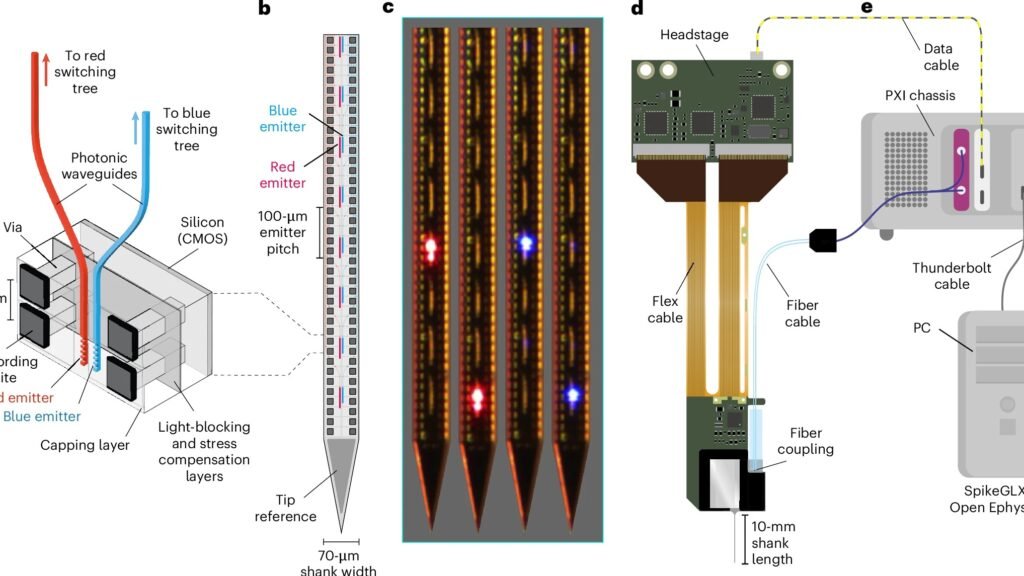
Understanding how neurons communicate within deep brain regions has long been limited by tools that can either record electrical activity or manipulate specific cells, but not both at the same time. A new technology called “Neuropixels Opto” is addressing this challenge by combining electrophysiology and optogenetics into a single probe capable of simultaneously monitoring and influencing neuronal activity. The system, developed through an international collaboration led by researchers at University College London, offers a way to study how individual neurons contribute to complex behaviors and neurological disorders. The work was published in Nature Methods and represents a major advance in the ability to observe and test causal relationships within neural circuits.
Neuropixels Opto integrates hundreds of recording sites with microscopic light emitters on a silicon probe thinner than a human hair. This design allows scientists to capture electrical signals from neurons distributed along the probe while delivering precisely targeted light to activate or silence specific cells. The combination makes it possible to observe how manipulating one group of neurons affects the surrounding network, something that has been difficult to achieve in deeper brain structures where light delivery can interfere with sensitive recordings. Researchers describe the technology as a way to reveal how neurons operate both collectively and independently within the brain’s architecture.
Early experiments in mice show that the tool can uncover patterns of neuronal activity that were previously inaccessible. By selectively stimulating or inhibiting defined neuron types while recording from nearby cells, scientists can map how different components of the cortex contribute to behavior. One finding suggests that cortical neurons may operate more independently than expected, challenging assumptions about how interconnected these cells are. This level of precision opens new opportunities to study how information flows across brain regions and how specific circuits support perception, learning, and decision making.
The implications extend to neurological and psychiatric conditions. Disorders such as Alzheimer’s disease, schizophrenia, and Parkinson’s disease involve disruptions in how neurons communicate. Neuropixels Opto provides a way to examine these disruptions at the level of individual cells and circuits, potentially guiding the development of more targeted therapies. The project is part of a broader effort to advance large scale neural recording technologies and make them more accessible to researchers worldwide. By enabling simultaneous recording and manipulation of deep brain circuits, Neuropixels Opto marks a significant step forward in the tools available for studying the brain.
Article from UCL: Neuropixels Opto sheds new light on deepest regions of the brain
Abstract in Nature Methods: Neuropixels Opto: combining high-resolution electrophysiology and optogenetics
