
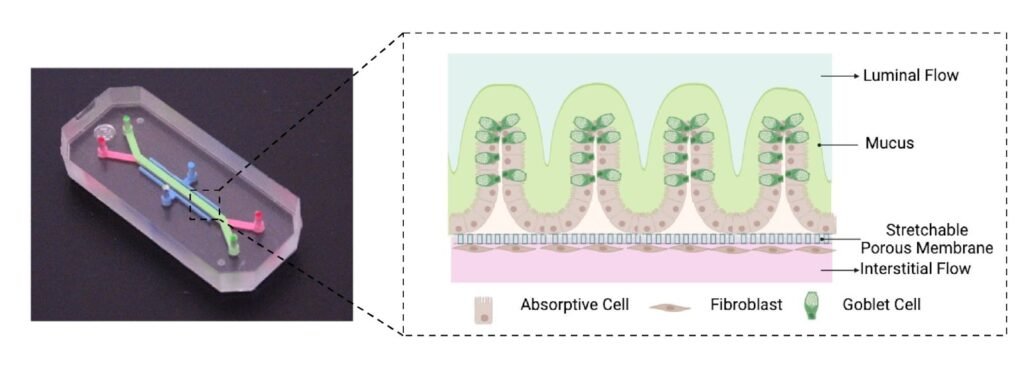
Inflammatory bowel disease remains difficult to study because its complex immune and microbial interactions cannot be replicated in traditional lab models. Researchers at Harvard University’s Wyss Institute have developed a microfluidic “gut‑on‑a‑chip” system that recreates the dynamic environment of the human intestine, allowing scientists to observe how inflammation develops and how individual patients respond to therapy. Their goal is to uncover molecular signatures that could guide personalized treatment for Crohn’s disease and ulcerative colitis.
The chip contains living human intestinal cells cultured alongside immune cells and gut bacteria under controlled flow conditions. This setup mimics the mechanical motions and biochemical gradients of the intestine, enabling real‑time observation of how inflammation arises. By introducing patient‑derived cells and microbiota, the researchers can reproduce disease‑specific responses that vary from person to person. This approach bridges the gap between animal models and clinical trials, providing a controllable yet physiologically relevant platform for studying chronic intestinal disorders.
Using the system, the team identified distinct molecular patterns associated with inflammatory flare‑ups. They found that certain bacterial metabolites and immune signaling molecules trigger epithelial damage and cytokine release, while others promote healing. The chip also allowed them to test anti‑inflammatory drugs and biologics under conditions that closely resemble the human gut, revealing why some treatments succeed or fail depending on the patient’s microbiome composition.
The researchers emphasize that this technology could accelerate drug discovery and help clinicians tailor therapies to individual patients. Because the chip can be seeded with cells from specific donors, it enables precision modeling of disease progression and response to treatment. The Wyss team envisions expanding the platform to include other organs and immune components, creating an integrated “body‑on‑a‑chip” system for systemic disease research.
By decoding the cellular and microbial interactions driving inflammatory bowel disease, the gut‑on‑a‑chip offers a new window into personalized medicine and could transform how chronic intestinal inflammation is understood and treated.
Article from Harvard University: Decoding inflammatory bowel disease – on a chip
Abstract in Nature Biomedical Engineering: Human inflammatory bowel disease-on-a-chip for modelling disease progression, cancer initiation and sex-specific effects
