
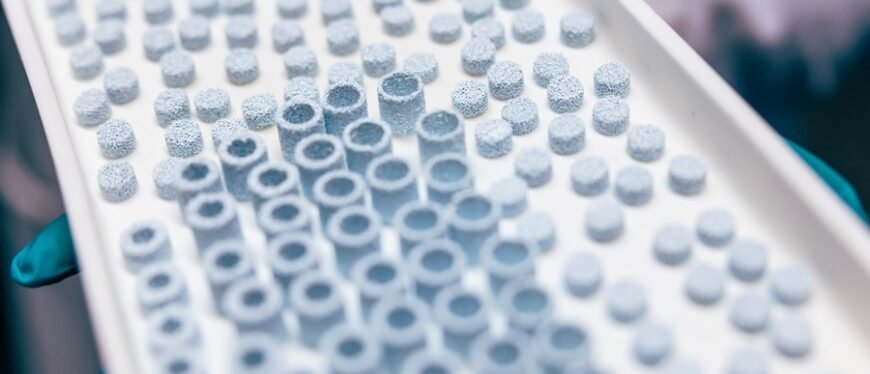
Bone reconstruction remains difficult when large defects occur, because current implants often fail to match the mechanical behavior and biological complexity of natural bone. Researchers at Tampere University in Finland are working to solve this problem by developing 3D printed ceramic implants that closely replicate the architecture and performance of real bone. Their goal is to create patient specific implants that integrate more effectively with the body and support long term healing.
The team focuses on calcium phosphate ceramics, which are chemically similar to the mineral component of bone. These materials are already used in clinical settings, but traditional manufacturing methods limit their shapes and internal structures. By using advanced 3D printing, the Tampere group can design implants with controlled porosity, tailored mechanical strength, and internal channels that guide tissue growth. This level of customization allows implants to be matched to the patient’s anatomy and the specific biomechanical demands of the defect site.
One of the central challenges in ceramic implant design is balancing strength with biological performance. Highly porous structures encourage bone ingrowth, but they can also weaken the implant. The researchers address this by optimizing pore size, distribution, and geometry to achieve both mechanical stability and biological compatibility. Their printed ceramics can be engineered to mimic the hierarchical structure of natural bone, including the way forces are distributed through the material.
The team also studies how cells interact with the printed surfaces. Early results show that the ceramic scaffolds support cell attachment and proliferation, which are essential for successful integration. The researchers are exploring ways to further enhance biological performance by incorporating bioactive molecules or surface treatments that encourage faster healing. Because the implants can be printed directly from patient imaging data, they can be shaped to fit complex defects that would be difficult to treat with off the shelf materials.
Tampere University’s work is part of a broader effort to bring personalized regenerative medicine into routine clinical practice. By combining ceramic chemistry with precise 3D printing, the team aims to create implants that behave more like living bone and reduce the need for secondary surgeries. Their approach could benefit patients recovering from trauma, tumor removal, or congenital defects, and it may eventually support the development of fully regenerative bone replacements.
Article from Tampere University: 3D printing bones: Researchers develop ceramic implants that mimic natural bone
Abstract in Materials Today Bio: Biomimetic bone calcium phosphate-based scaffolds fabricated via ceramic vat photopolymerization: Effect of porosity, sintering temperature, mineralogical phases and trace elements on the osteogenic potential
