
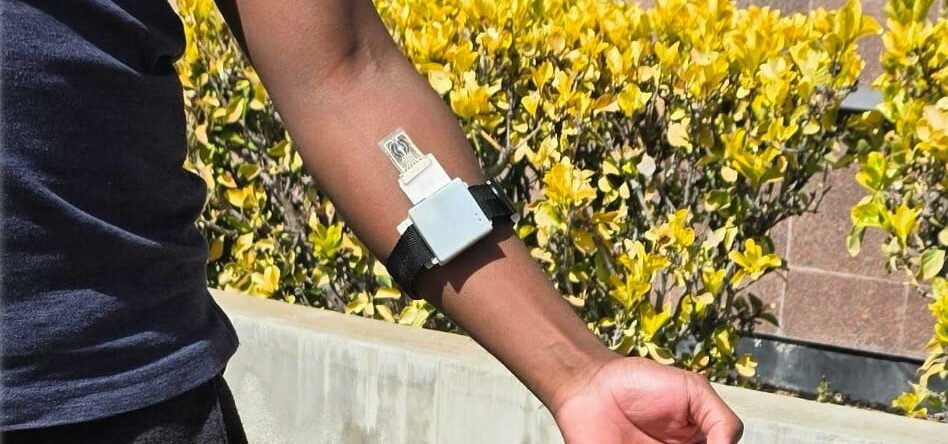
Long term molecular health monitoring has been difficult to achieve because most wearable sensors lose accuracy as their sensing surfaces degrade. University of California, Irvine researchers have developed a new bioelectronic sweat sensor that solves this problem by regenerating its sensing interface on demand and operating without a battery. Their goal is to create a practical, continuous monitoring platform that can track key biomarkers outside clinical settings for weeks at a time.
The device is called the In Situ Regeneratable, Environmentally Stable, Multimodal, Wireless, Wearable Molecular Sweat Sensing System, or “IREM W2MS3”. It is a flexible skin patch that communicates wirelessly with an Android smartphone or a custom wristwatch style reader. The system measures four clinically relevant biomarkers in sweat: cortisol, glucose, lactate, and urea. These molecules reflect stress response, metabolic activity, physical exertion, and kidney function, giving users a multidimensional view of their physiological state.
A major challenge in sweat biosensing is that molecules accumulate on the sensing surface over time, reducing accuracy. The UC Irvine team addressed this by designing a sensing layer that can be refreshed electrochemically. By applying a controlled low voltage, the device strips away bound molecules and restores sensitivity without requiring replacement or manual cleaning. This regenerative capability allows the sensor to operate continuously for extended periods, even in real world environments.
Another barrier to long term sweat monitoring is the need for consistent sample collection. Many sensors rely on physical activity to generate sweat, which limits when and how they can be used. The IREM W2MS3 overcomes this by using wireless power from a smartphone or reader to activate a biocompatible hydrogel that induces localized perspiration. This feature ensures that the device can collect fresh sweat on demand, enabling reliable measurements throughout the day without disrupting normal routines.
The system is battery free and powered through near field communication, which simplifies its design and improves durability. The researchers emphasize that the platform could support applications in chronic disease management, stress and mental health monitoring, sports performance, preventive medicine, and remote community health programs. Because it is thin, flexible, and easy to wear, the sensor is designed for long term use outside laboratory settings.
By combining regenerative sensing, wireless power, and multimodal biomarker tracking, the UC Irvine team has created a wearable platform that brings continuous molecular health monitoring closer to everyday use.
Here’s a brief video that explains more:
Article from UC Irvine: UC Irvine researchers invent a wearable, bioelectronic sweat sensor for long-term health monitoring
Abstract in Nature Biomedical Engineering: Wireless and in situ regenerable multimodal wearable bioelectronic sweat sensor for continuous biomarker monitoring in everyday settings
