
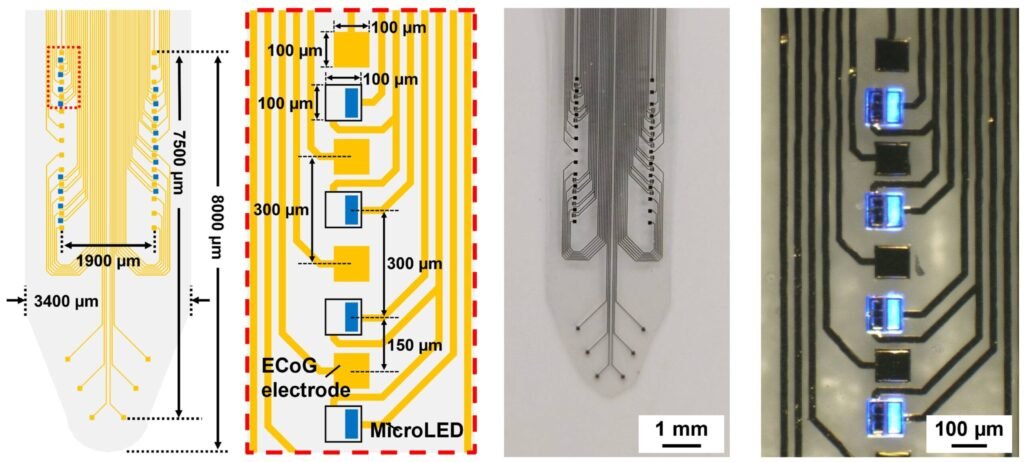
Studying deep brain activity normally requires inserting rigid probes directly into neural tissue, a process that can cause inflammation, scarring, and long term disruption of the very circuits researchers hope to understand. Neuroscientists have long sought a way to record from deeper cortical layers without physically penetrating the brain. A team of engineers and neuroscientists from Meijo University in Japan has now developed a flexible neural sheet that can slide into natural spaces between brain structures and record electrical activity from regions that were previously accessible only through invasive penetration. Their approach offers a gentler alternative for mapping neural circuits in both research and clinical settings.
The device is built from an ultrathin, flexible polymer sheet embedded with microelectrodes. Its design allows it to conform to the curved surfaces of the brain and move with tissue rather than cutting through it. Instead of being inserted vertically into the cortex like a traditional probe, the sheet is gently guided into the subarachnoid space, a fluid filled layer that naturally separates the brain from its protective membranes. Once in place, the sheet unfolds and settles against the cortical surface, allowing its electrodes to detect signals from deeper layers through volume conduction.
Researchers tested the device in animal models and found that it could record neural activity from regions several millimeters below the surface. This depth is typically reachable only with penetrating electrodes. The team reported that the sheet remained stable over time and produced high quality recordings without triggering the inflammatory responses commonly associated with implanted probes. Because the sheet does not pierce tissue, it avoids damaging blood vessels and reduces the risk of long term scarring.
One of the most promising aspects of the technology is its ability to cover large areas of the brain. Traditional penetrating probes sample only narrow columns of tissue, but the flexible sheet can span broad cortical regions while still accessing deeper signals. This combination of coverage and depth could help researchers study distributed neural networks that coordinate complex behaviors. The sheet’s softness and biocompatibility also make it a candidate for chronic implantation in studies that require long term monitoring.
The team envisions future versions that incorporate stimulation capabilities, allowing the same device to both record and modulate neural activity. They also note that the sheet could be adapted for human use in conditions where deep brain monitoring is valuable but invasive penetration carries significant risk. By providing access to deep cortical signals without damaging tissue, the flexible neural sheet represents a significant advance in neural interface technology.
EurekAlert News Release: Flexible neural sheet device reaches deep cortical regions without brain penetration
Abstract in Applied Physics Express: Flexible MicroLED–electrocorticography sheet for wide-area bidirectional neural interface in mice
