
Soft robots and biomedical devices often struggle to achieve the complex, coordinated motions that biological muscles perform with ease. Traditional synthetic actuators can contract or expand, but they rarely bend, twist, and coil in controlled ways. Researchers at Harvard University’s John A. Paulson School of Engineering and Applied Sciences have developed a new 3D printing strategy that addresses this limitation by creating programmable filaments that behave like artificial muscles. Their approach allows slender, hair like structures to bend, twist, expand, or contract when heated or cooled, giving engineers a new way to design motion into soft materials.
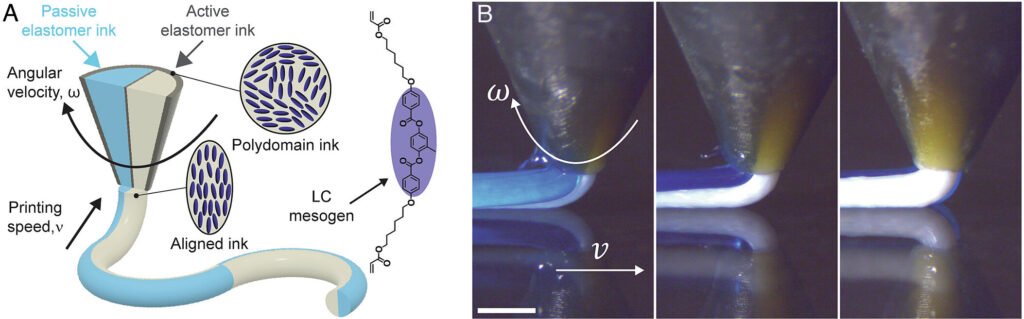
The research team focused on a printing method called rotational multimaterial 3D printing. This technique extrudes two materials side by side through a nozzle that spins as it prints. One material is an active liquid crystal elastomer that contracts along a preferred direction when heated above a transition temperature. The other is a passive elastomer that maintains its shape and provides structural guidance. By controlling how these two materials are arranged around the filament’s cross section, the researchers can pre program how the filament will deform when activated.
Because the nozzle rotates during printing, the active material is deposited with a helical molecular alignment. This alignment determines how the filament bends or twists when heated. Even a simple bilayer filament will curve as one side shortens and the other resists. More complex patterns allow for coiling, spiraling, or multi axis motion. The key advantage is that the motion is encoded directly during printing, eliminating the need for post processing or assembly of multiple layers.
The team validated their designs using mechanical modeling and X ray scattering at Brookhaven National Laboratory to confirm molecular alignment. They then built functional prototypes to demonstrate practical uses. These included temperature controlled filters that open or close based on heat, and soft grippers that can pick up multiple objects when warmed and release them when cooled. The researchers also printed lattices that morph into dome shapes when heated, matching predictions from their simulations.
This work shows how rotational multimaterial 3D printing can bring biological like complexity to synthetic materials. By precisely placing active and passive regions within a filament, engineers can design soft structures that move in predictable and customizable ways. The approach opens new possibilities for soft robotics, biomedical devices, and materials that change shape on demand.
Here’s a brief video that explains more about the technology:
Article from Harvard University: Toward Artificial Muscles That Bend and Twist on Demand
Abstract in PNAS: Rotational 3D printing of active–passive filaments and lattices with programmable shape morphing
