
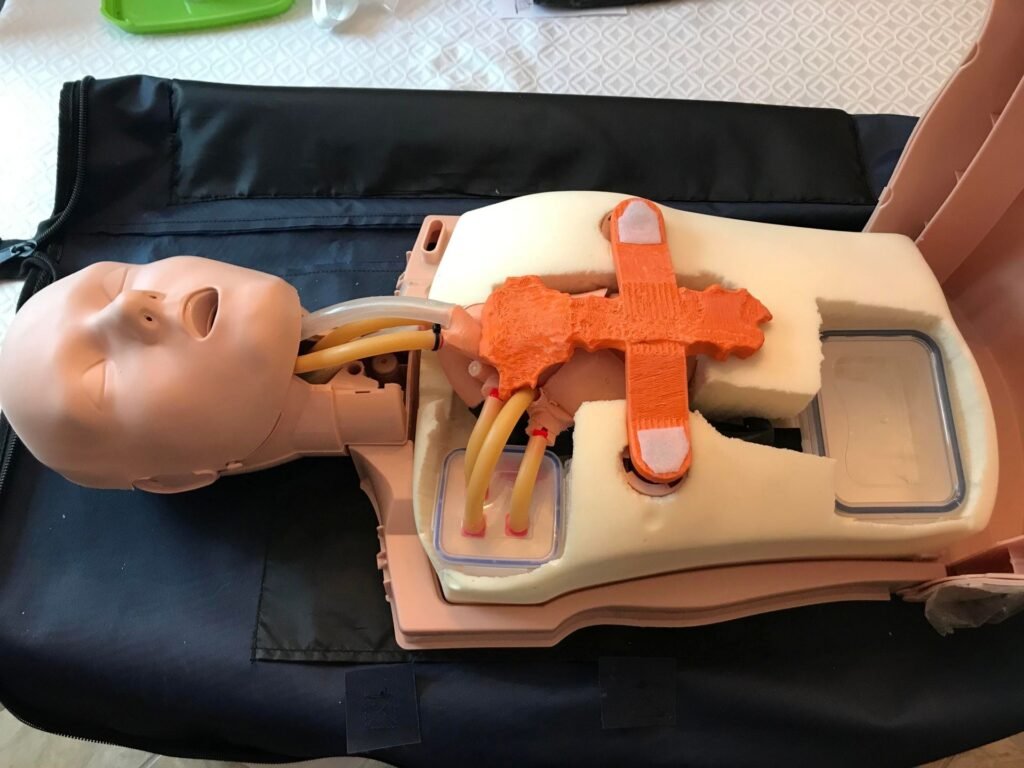
Medical emergencies in space pose a serious challenge because the human body behaves differently in reduced gravity, and lifesaving procedures developed on Earth may not work the same way in orbit. Cardiopulmonary resuscitation is one of the most critical interventions during a cardiac arrest, yet very little is known about how chest compressions affect blood flow when gravity is no longer pulling fluids downward. Researchers at Concordia University have created a CPR simulator designed specifically for space environments to study how blood circulates during resuscitation in microgravity. Their goal is to help astronauts perform effective CPR during long duration missions where immediate medical evacuation is impossible.
The simulator is built around a detailed computational model that represents the human cardiovascular system. It incorporates the physics of fluid movement in reduced gravity and simulates how chest compressions generate pressure changes that move blood through the heart and vessels. The research team wanted to understand whether standard CPR techniques produce enough circulation in space or whether astronauts will need modified methods to maintain adequate perfusion.
To validate the model, the team compared its predictions with data from parabolic flight experiments that create short periods of microgravity. These flights allowed researchers to observe how fluids shift in the body when gravity is removed. The simulator successfully reproduced these patterns, giving the team confidence that it could be used to explore CPR performance under different conditions. The model also allowed them to test how variations in compression depth, rate, and body positioning influence blood flow in reduced gravity.
One of the most important findings is that microgravity changes the baseline distribution of blood in the body. Without gravity pulling blood toward the lower extremities, more fluid remains in the upper body and central circulation. This shift alters how pressure waves travel during chest compressions. The simulator showed that some CPR techniques that work well on Earth may be less effective in space because they rely on gravitational forces that no longer exist. The research suggests that astronauts may need alternative positions or bracing strategies to generate sufficient compression force and maintain stable contact with the patient.
The Concordia team designed the simulator to be adaptable so that future researchers can incorporate new physiological data from space missions. They envision the tool being used to train astronauts, refine CPR protocols for microgravity, and support mission planners as human spaceflight moves toward longer stays on the Moon and eventual travel to Mars. By revealing how blood flow responds to chest compressions in reduced gravity, the simulator provides essential knowledge for protecting astronaut health during medical emergencies far from Earth.
Article from Concordia University: Concordia-designed CPR simulator for space use tracks the differences of blood flow in reduced gravity
Abstract in npj microgravity: A high-fidelity simulator for evaluation of hemodynamic response during cardiopulmonary resuscitation in hypogravity environments
