
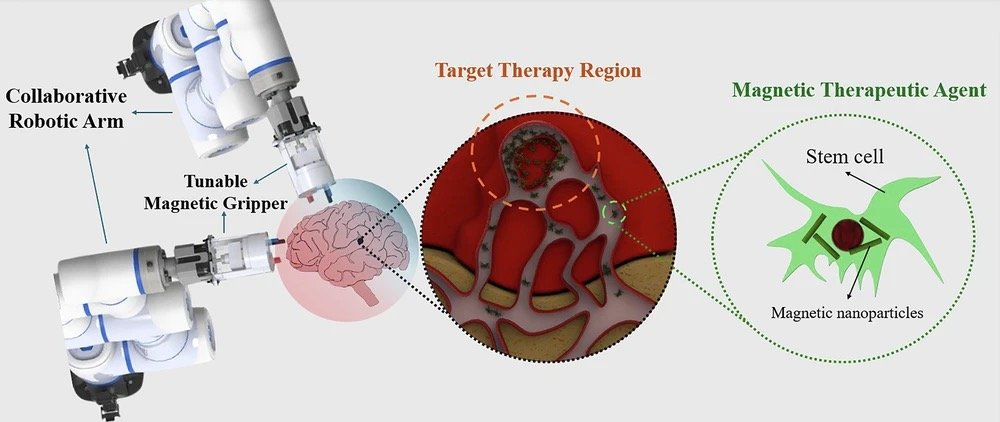
Conventional cancer therapies often struggle to reach deep or irregular tumor sites without harming surrounding tissue. Scientists at the University of Essex have developed a new magnetic control system that could make future treatments far more precise. Their innovation, called the “Tuneable Magnetic End Effector” (TME), enables the manipulation of microrobots and magnetic particles inside the body with unprecedented accuracy, opening the door to minimally invasive procedures that deliver drugs or perform microsurgery directly at the disease site.
Developed by the Robotics for Under Millimetre Innovation (RUMI) Lab, the TME generates magnetic fields that can be switched, shaped, and redirected in real time. Mounted on robotic arms and guided by artificial intelligence, it can control individual microrobots, soft magnetic structures, or even coordinated swarms of particles. This flexibility allows clinicians to steer therapeutic agents through complex biological pathways, such as blood vessels or tissue networks, to reach hard‑to‑access tumors.
Unlike most magnetic systems that rely on continuous electrical power, the TME uses permanent magnets that can be physically repositioned to alter the magnetic field. This design makes the system smaller, more energy‑efficient, and easier to control—qualities that are essential for medical applications. In laboratory tests, researchers successfully guided tiny magnetic objects through branching paths, shaped soft robotic materials, and controlled groups of magnetic particles simultaneously. Using two TMEs together, they created separate zones of magnetic influence within the same space, demonstrating the potential for multi‑region control inside the body.
Researchers explained that magnetic microrobotics could lead to a new generation of precision medicine. The technology could one day allow doctors to perform delicate procedures or deliver therapies wirelessly, reducing the need for invasive surgery and minimizing side effects compared to chemotherapy or radiation.
The Essex team plans to refine the TME for use in realistic medical environments and explore how it can guide microrobots for targeted cancer therapy. By combining robotics, magnetism, and AI, their work points toward a future where clinicians can navigate inside the body with microscopic precision, transforming how cancer and other complex diseases are treated.
Article from the University of Essex: Microrobotics technology to help transform cancer treatments of the future
Abstract in Communications Engineering: Magnetic field control with dual robotic tunable magnetic end effectors
