
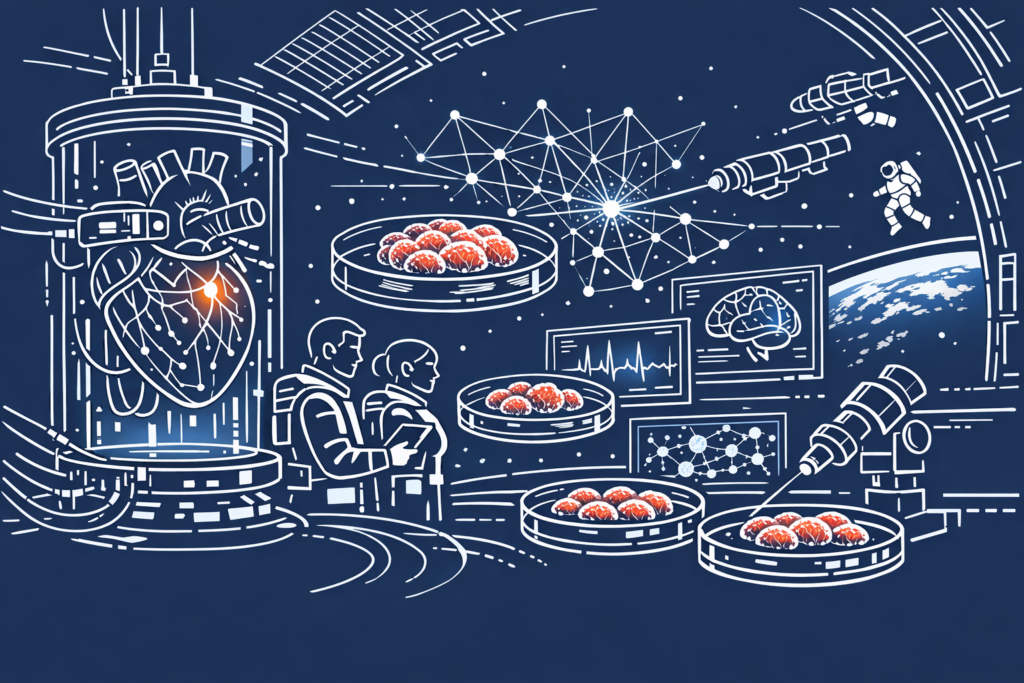
Heart failure remains a leading cause of death worldwide, and progress is often slowed by how long it takes for disease related changes to appear in patients on Earth. In normal gravity, the heart and muscles weaken gradually over years, making it difficult to study early mechanisms of failure or to test new therapies quickly. By moving the problem into space, researchers are compressing that timeline. Arun Sharma and his team are using the microgravity environment of the International Space Station to study how heart tissue weakens, adapts, and can be rebuilt, with the goal of improving both heart failure treatment and tissue engineered therapies.
In microgravity, cardiovascular deconditioning happens much faster than it does on Earth. The heart and skeletal muscles lose strength over weeks instead of years, providing a kind of accelerated model of disease. Sharma, who directs the Center for Space Medicine Research at Cedars Sinai, uses this environment to examine changes in heart muscle contractility and metabolism that resemble those seen in heart failure. By tracking how heart cells and tissues respond to low gravity, his group can identify molecular pathways that drive weakening and recovery. These insights may help clinicians better prepare patients for heart transplant and maintain organ function while they wait for a donor.
The team is also sending stem cell derived heart tissues and organoids to space. These miniature three dimensional heart models mimic key aspects of cardiac structure and function. In orbit, they age and remodel more quickly, allowing researchers to test drug candidates and study how tissue architecture changes under stress. Microgravity appears to support the growth of more complex three dimensional structures and richer blood vessel networks than are typically achieved in standard laboratory conditions. That makes space an attractive manufacturing environment for advanced cardiac patches and other regenerative products.
One long term goal is to use induced pluripotent stem cell derived heart muscle patches as bridge therapies for patients with severe heart failure. These patches could stabilize or partially repair failing hearts, reducing the number of people who require full organ replacement. Space enhanced manufacturing may improve the strength and physiological realism of these patches by promoting better tissue organization and vascularization. Insights from space experiments can then be translated back to Earth, guiding how tissues are grown, conditioned, and tested in conventional facilities.
By treating space as both a stress test and a fabrication lab for heart tissue, Sharma’s work links fundamental disease mechanisms with practical regenerative strategies. The approach offers a faster way to study how heart muscle fails and recovers and points toward more robust engineered tissues that could support patients before and after transplant.
