
Long term heart monitoring is essential for diagnosing cardiac conditions, yet the experience is often uncomfortable for patients. Conventional electrocardiogram electrodes rely on sticky adhesives that can irritate the skin and gels that dry out over time, degrading signal quality. Patients may need to wear these sensors for hours or even days, and the discomfort can discourage consistent use. Researchers at North Carolina State University set out to solve this problem by developing a new material that conforms naturally to the skin and captures high quality ECG signals without adhesives or gels. Their goal was to create a sensor that patients could wear comfortably while moving, without sacrificing clinical performance.
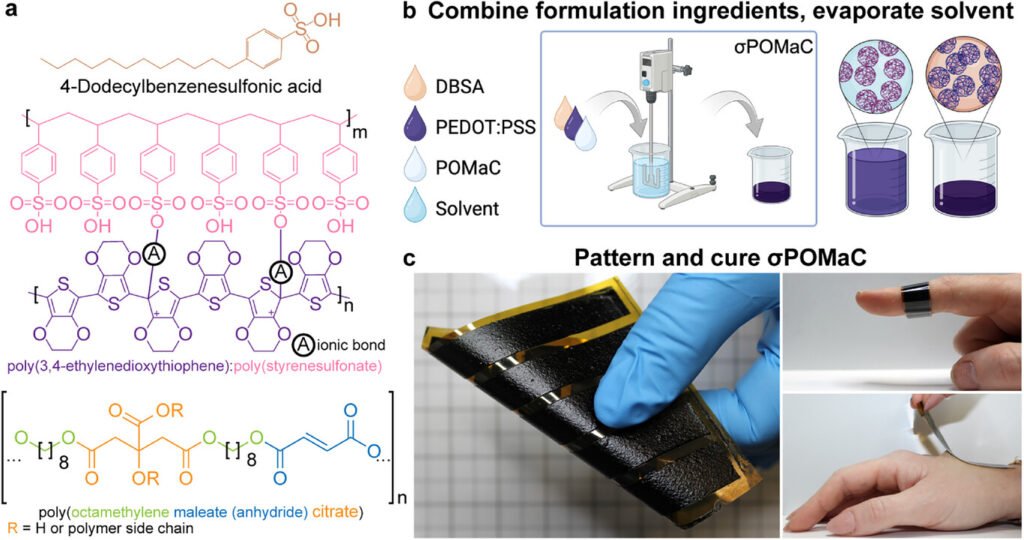
The team focused on a polymer called POMaC, which already had the softness and stretch needed for skin contact but lacked the electrical properties required for sensing. To transform it into a functional electrode, the researchers blended POMaC with a conductive polymer and a surfactant while the material was still in liquid form. This mixture could then be screen printed or cast into molds depending on the desired shape. After curing, the material became an elastic solid with a conductive internal matrix capable of picking up ECG signals. The resulting electrodes adhered gently to the skin, held the weight of connecting wires, and could be removed without pulling hair or causing irritation.
In proof of concept testing, the new electrodes performed comparably to commercial ECG sensors. The researchers evaluated them using both a standard clinical ECG device and an experimental wireless patch under development. In both cases, the material delivered reliable readings while maintaining comfort and flexibility. Because the electrodes can be manufactured using existing processes, the team believes the technology could be scaled without major changes to production infrastructure.
The work addresses a long standing need for heart monitoring tools that patients can tolerate during daily activities. A sensor that conforms to the skin without adhesives or gels could improve compliance, reduce irritation, and support more accurate long term data collection. The researchers see potential applications in clinical monitoring, home based cardiac care, and wearable health technologies. Their approach demonstrates how reengineering a familiar material can lead to more patient friendly devices without compromising performance.
