
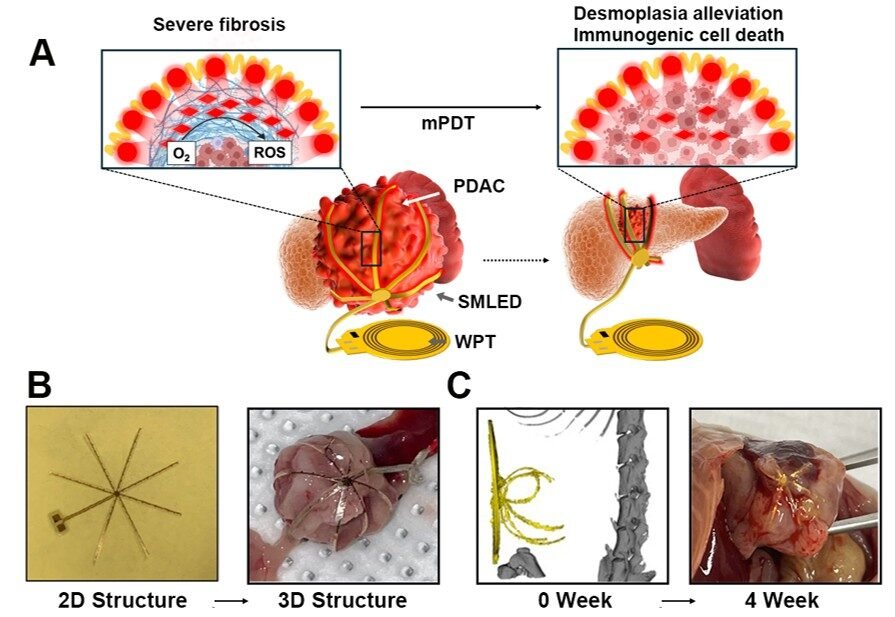
Researchers at the Korea Advanced Institute of Science and Technology (KAIST) have developed an implantable, shape‑morphing 3D micro‑LED device designed to overcome barriers in pancreatic cancer treatment. Conventional therapies are limited by the dense tumor microenvironment, which blocks drugs and immune cells, while external lasers used in photodynamic therapy cannot penetrate deep tissue and risk damaging healthy organs.
The new device uses a flexible, octopus‑like architecture that wraps around the tumor, maintaining uniform light delivery even as the tissue expands or contracts. This enables continuous, low‑intensity photostimulation that targets cancer cells while preserving normal tissue.
In in vivo mouse experiments, the technology reduced tumor fibrous tissue by 64 percent within three days and restored pancreatic tissue to normal. The device also maintained stable adhesion for four weeks without detachment.
Researchers describe the work as a new therapeutic paradigm that directly disrupts the tumor microenvironment. They noted plans to integrate the system with artificial intelligence for real‑time monitoring and personalized treatment, and emphasized the team’s interest in advancing clinical trials and commercialization. The breakthrough could support immune‑based strategies for treating difficult cancers.
Article from KAIST: Octopus-Inspired 3D Micro-LEDs Pave the Way for Selective Pancreatic Cancer Therapy
Abstract in Advanced Materials: Deeply Implantable, Shape-Morphing, 3D MicroLEDs for Pancreatic Cancer Therapy
