
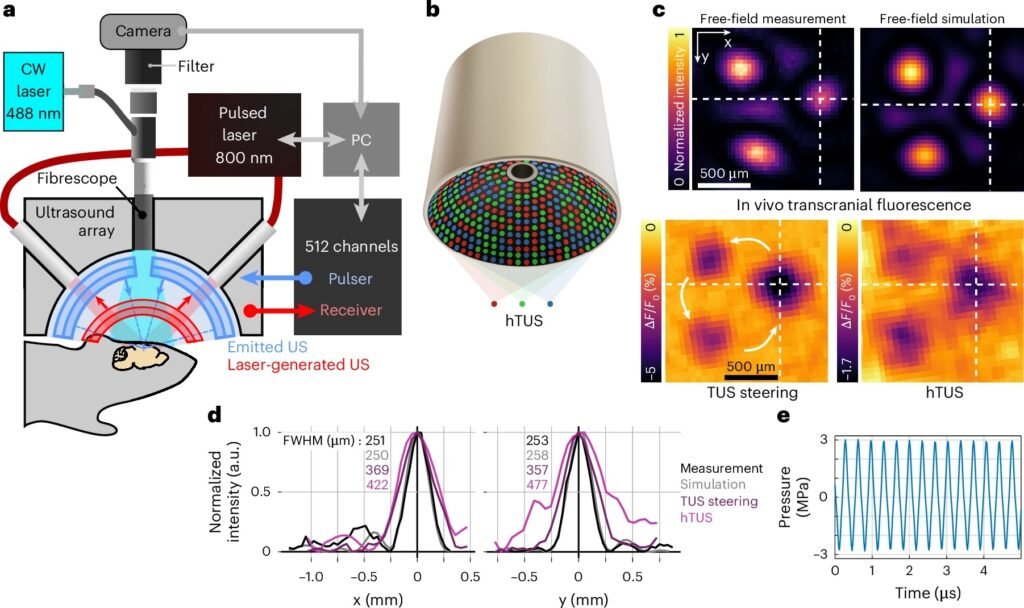
A team of researchers at ETH Zurich has developed a novel technique that uses ultrasound holograms to influence brain networks with high precision. This approach could open new possibilities for treating neurological disorders and studying brain function without invasive procedures. Unlike traditional ultrasound methods that focus energy on a single point, the ETH system creates complex three-dimensional pressure patterns that can target multiple brain regions simultaneously.
The technique works by generating holographic ultrasound fields using a specially designed transducer array. These fields can be shaped to match the geometry of specific brain networks, allowing researchers to stimulate or modulate activity across interconnected regions. In animal studies, the team demonstrated that the holograms could activate distinct neural circuits and influence behavior, such as movement and attention.
One of the key advantages of this method is its noninvasive nature. The ultrasound waves pass through the skull without requiring surgery or implants, making it safer and more accessible than techniques like deep brain stimulation. The system also offers millimeter-level spatial resolution and can be adjusted in real time, providing a flexible tool for both research and clinical applications.
Article from ETH Zurich: Researchers use ultrasound holograms to influence brain networks
Abstract in Nature Biomedical Engineering: Holographic transcranial ultrasound neuromodulation enhances stimulation efficacy by cooperatively recruiting distributed brain circuits
